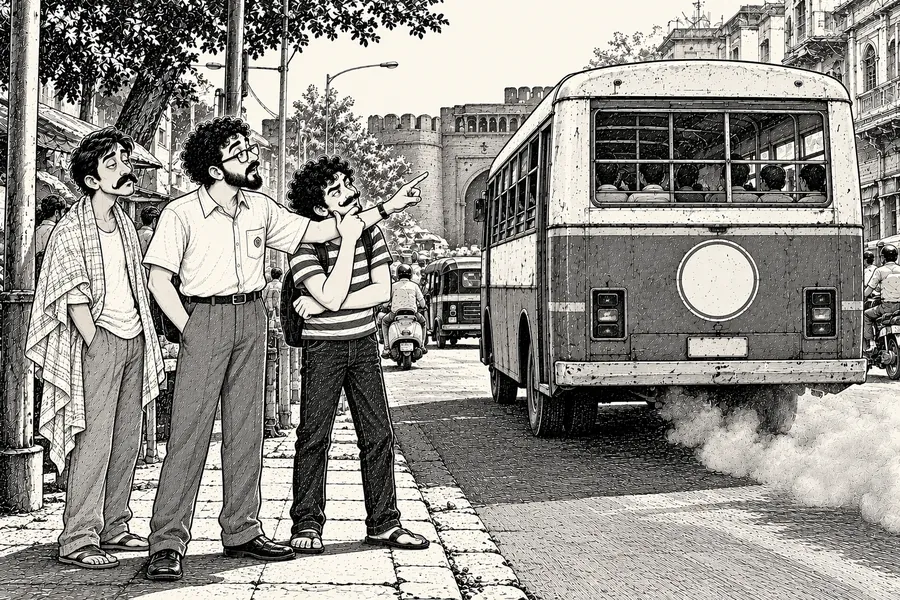
I have heard of the great California Gold Rush. It is said that many people actually did find gold back then.
A few years back, in the sleepy city of Pune, there was a similar rush, a Gold and Fortune Rush. However, true to 21st-century futurism, rather than an actual gold rush, this was a Futures and Options Gold Rush!!
Point Break
It was a really cold winter morning, one of those mornings when you wake up, stay awake for half an hour or so, and then drop back into bed and doze off. Half asleep, the dreams are vivid, maybe because it is 10 am and the diffused light in the room makes the scenery vivid! Also, for some unknown reason, you have control over the events in your dreams. There I was at some Himalayan foothill, planning my arduous climb to the summit, pondering how to navigate the heights unassisted, without ropes or any safety equipment (à la Point Break!). Sadly, that morning I had forgotten to put my phone on silent, and that tring tring broke my adventurous ardour.
In my partial state of enlightenment, in a very lazy manner and with an equally lazy tone, I picked up the call and said, “Hello.”
On a scale of excitement from one to a hundred, I was at minus 10, and the caller at the other end was at plus 110. That hyper-excited dude, in an exuberant tone, said, “Did you read today’s newspaper?”
His loud tone jolted me a bit. I opened my eyes to check who was calling: it was ‘P.cat’. (This is not the time to ponder why my contact list is full of nicknames instead of full names.) I put the call on speaker and, trying to muster some enthusiasm to match my caller’s, said, “Yes…” I actually wanted to elaborate, but saying “yes” in a rather high tone (scale reading: plus 10) had sapped most of my lazy energy, and that one word was all I could utter.
At the other end was the polar opposite. He doubled down on his tone and, in a rather accusatory manner, hurled his question at me: “Then why did you not tell me?”
Now, obviously the grammar of his question is wrong; however, since my grammar is also not that great, it was not worth chastising him over it. But he was being unreasonable. A typical newspaper has an average of 14 pages, each page with 5 main articles, 5 short articles and roughly 4 advertisements. Oh yes, count the astro column, the cartoon, the TV and movie schedules, the Page 3 pics, etc. Now what exactly, from this vast trove of letters and images, was I supposed to read, digest, relate, and then think, this might be of interest to A, B or C, so I must call A, B and C and tell them?
In my slumber state, I had no energy to rant at him, so I dropped back to my minus-10 tone and said, “What.”
His enthusiasm was rising like the mercury in a thermometer dipped in boiling water, and, quite unnecessarily, he got louder. I heard him as loud as my phone’s speaker could manage: “In today’s paper it says today is Grand Kuber Muhurat!”
A Muhurat for Everything
Muhurats in India are like the “days” in the West: Valentine’s, Father’s, Mother’s, Friendship, Women’s, etc. They do have a cultural or astrological significance, and some history attached to them, but like their western counterparts they are now mostly used for their commercial value, to boost sales in the economy.
Ignoring the two “todays”, I just wanted to ask him: who, what, when, why, how! However, in India, whenever a muhurat is attached to anything, an emotional connect is implicitly attached to it, and these emotions are basically easily offendable sensitivities. Even in that half-awake, half-asleep mode, I was conscious of such sentiments (ingrained cultural training!), and in a very polite tone I replied, “I did not read the paper properly, so I must have missed it.”
The hyper-excited chap then proceeded to explain the significance of the Grand Kuber Muhurat. He had received a text (from whom, is not known), and the text said that today’s paper (which paper, is not known) mentions that whosoever offers their prayers at the Kuber temple before 8:30 pm will be showered with immense wealth and riches, as today is (yes, you guessed it right) the Grand Kuber Muhurat.
The chap had forwarded the same text to at least a dozen people; however, for some reason, I had the privilege of a direct phone call. The reason was not that he wanted to share the wealth with me, but that his endeavour had got stuck at a very important hurdle, which he now posed to me: “Where is the nearest Kuber temple?”
At that moment my brain was buzzing with several questions; however, my ingrained cultural training prevented me from asking them. Maintaining a calm demeanour, I replied, “No, I don’t know.”
To which he replied, “Then ask someone around.”
Thinking Hu-Man
I woke up and looked around. I was alone in my room. I walked out of my room and found I was alone in the house: it was 10:30 am, and everyone had left for work. I walked out of the house, only to find my neighbour’s door locked! Was I alone in the building, I wondered? So I took to the stairs, and lo, I saw an anthropoid walking up them, one I knew well enough to pose to him the purpose of my travels (travelling in shorts, a phenomenally old T-shirt, no footwear, hair pointing in random directions). I asked the man, “Do you know the location of a Kuber temple nearby?”
Now, hu-man is a thinking animal, and this one thought. He asked why I needed this information, so I relayed the entire story. Mine began with “I got a call”, and the chap on the speakerphone corrected my version whenever I strayed from the original plot line. Having consumed the entire information, the man now had the means and the context to answer my query. He replied, “No, I don’t know where the nearest temple is,” and before leaving the stage he added, “If you come to know of one, inform me. I will also come with you.”
He went up the stairs typing on his phone. I am pretty sure another chain of texts began right there.
I told P.cat I would get ready, have a bath, and then we would figure it out.
Going Viral
I went back to my bed and, after a few more minutes of lying there, reluctantly pushed myself to get ready. The reason was simple: P.cat lived nearby, and I knew his patience level. Sooner or later, he would be at my doorstep.
Getting ready took me about an hour and a half. It was noon by the time I sat down for breakfast. Glancing at my phone, I saw that I had already received 5 messages from 5 different people about the muhurat. While I was having breakfast, another 5 called with the same information. The whole thing had taken over Pune, it seemed, and was growing by the minute.
As anticipated, the hyper-excited chap ended up hyperventilating at my doorstep. His first question as I opened the door was, “Did you find where the temple is?”
The Temple Hunt had begun!
Normally such a thing would have faded out, but this one had all the ingredients of an excellent marketing campaign:
- A limited-time offer, ending 8:30 pm the same day!
- Divine attributes, by invoking God. Lord Kuber, no less!
- An appeal to the innermost desire for spiritual enhancement (gaining wealth without doing any work!)
Today, we would call it going viral.

The Temple Hunt
That dude, without bothering for my consent, made me an accomplice in his endeavour, and off we went on his bike in search of the elusive treasure. From one acquaintance to another, he rode his 11.3 BHP engine like a man on a mission. Each iteration began with a mild enquiry about the temple, followed by a detailed description of the muhurat. Some places offered us tea; some were kind enough to offer snacks, chakli, etc. However, every interaction ended with the same outcome: “Don’t know where the temple is!”
Though I was happy getting a regular food recharge every now and then, I still wondered why we were wasting so much fuel traversing the dunes of Pune, navigating potholes and crossing dug-up drainage lines, when we could have got the same information with a phone call! However, my Sarathi (charioteer; here, the rider) was beyond all logic, determined to unearth the treasure. I mean, the address of the temple.
Each trip took roughly half an hour, travel and food included. By 5 pm we had probably touched every nook and corner of the city. The riding dude was feeling the heat now and was losing hope. And when all hope is lost, what do we do? We go to S.P.’s Canteen and have a nice samosa pav with kokam or lime juice.
Not the College Canteen
Now, S.P.’s Canteen is not the official canteen of S.P. College, Pune. The college’s official canteen is within the premises, has a name plate saying “College Canteen”, and does not have the letters S and P on it. S.P.’s Canteen (the one with the letters S and P on the name plate) is actually outside the premises, a good 100 m from the entrance, and yet it has more college students snacking than the College Canteen. The reason for pointing this out is simple: I am diagressing here. Plus, if you have samosa and juice at the College Canteen, it is not as good as the one at S.P.’s.
Back to our treasure hunt. We reached the last point of solace and got off the bike. At that moment I was preoccupied with a very important question: should I go for samosa pav and kokam, or should I opt for lime juice? A friend of ours was at the counter, ordering, well, kokam. On seeing him, my first question was, “What are you doing here!”
The exclamation mark is because this new chap in the story lived miles away, in a faraway place called Aundh. If you are not from Pune: Aundh is that part of Pune which is beyond Pune. It is beyond Pune University, basically beyond University Chowk. That chowk is one massive chowk, and if you got stuck at it, it took a minimum of 15 minutes to get across. Now they have put a flyover there to add to the chaos; back then it was merely chaotic. Hence, you crossed the chowk only if you had to, only if your life depended on it. (If you are not aware of what a chowk is: in other cities of the world it is called an intersection, usually with traffic lights to control the flow of things: vehicles, people, occasionally dogs.)
Hence my surprise at seeing the guy from beyond the realms standing there at the counter.
He replied, “Kuber Muhurat.”
Oh! We were not alone; we had company. However, there was one major point of divergence between us and our new companion: despite arriving from beyond Pune, he knew where the temple was!! He continued, “Before going to the temple, I thought I’d have something to eat.”
My chap now left me alone and took over the conversation, to extract the information from him with some sweet talk and, if need be, some sweet lime juice.

The Golden Route
The temple was on top of a mountain. Well, it does not look like a mountain any more, as the cement vegetation around it has almost subsumed it, but technically it is still a mountain. The mountain-top temple he was referring to was the mountain-top temple of Pune, popularly known as Parvati.
An outsider had beaten us in the quest. It was highly embarrassing; the Punekar in me felt ashamed. How could he know such a fact about my city when I didn’t? In my shame, I decided to stay away from the samosa, as a self-disciplinary punishment.
He went on to describe the route. Apparently, among the multitude of deities worshipped side by side at Parvati, Lord Kuber has a dedicated platform and a small temple. You cross the main temple, and at the rear exit a small staircase drops to the platform.
Indian temples are never standalone temples. A temple may carry the name of a particular deity, yet it is pretty inclusive. The main hall itself will have at least a dozen pictures and murals of other deities, and around the temple are another couple of dozen smaller temples, platforms and statues, revering a host of other gods. The idea is perhaps the convenience of offering prayers to all the deities in one place, and it is also somewhat spiritual, if you see it as an amalgamation of ideas and ideals. Parvati, in the same tradition, has several temples around it.
As I listened to the golden route, the picture brought back some fond memories. Years earlier I had been part of a football club, Phoenix FC (tagline: if you see an opportunity to score, just goal it!). The club’s ground was the Shahu College ground, known in the footballdom of Pune as the ligament-injury ground (a whole separate story; maybe later). The ground was next to Parvati, and our coach’s favourite routine was to send the boys running up the hill to touch the temple wall and come back: a 2 km sprint, every Tuesday and Thursday. It was an extremely tiring climb, legs used to give up, and the run resulted in a very lacklustre performance in the game that followed.
So a few smart ones (me included) used to reach the temple by the main entrance and hide in the premises, biding our time. Soon the huffing and puffing footballers would come running, touch the wall and head back. We would wait for the last boy to touch and turn, and then jump in and join the group. This saved us energy and effort, and on those days we usually overpowered and out-manoeuvred the others in the team. Eventually a string of such distinguished performances even led to a selection for the district team!
Back to our muhurat story: the platform described by the man from beyond the city was the very one we used to hide on. The moment I realised this, the fondness in my memories came to a screeching halt, and now both kokam and lime juice were off the table. In all wisdom, I kept quiet; otherwise my chap would surely have sacrificed me then and there.

Pehchaan Kisiko
Now the temple was in our sights. I mean literally in our sights: the top of Parvati can be seen from S.P.’s Canteen! My Sarathi started the bike. Thankfully he waited for me to sit; for a moment I thought that in his joy at meeting the Divine he had forgotten a mortal “me”, because he even forgot to say goodbye to our informant before taking off.
When we reached the foot of the hill, it was quite a scene. Normally, Parvati is a fairly desolate place: a few regulars who run up and down the stairs for no reason, and some pensioners who climb only halfway, to sit for a relaxing chat over a cup of tea. The garden, or what is left of it, around the staircase is typically left to the Devotees of Love, who sit there in intense worship. That day, however, the love devotees had given up the chance of exchanging promises of love and joined a queue, preferring promises of fortune from Lord Kuber. Even the pensioners were in the queue, searching for the lost glory of a lost age. The flower and coconut sellers who usually line the entrance were missing too; maybe they were part of the line. Joining them were people like us, who had dedicated their day to mining the fortune. Or rather, to finding the location of the mine.
Such an influx of devotees formed a long line, snaking around the temple.
We joined the line at around 6 pm. From then on we employed a very special tool at our disposal: Pehchaan kisiko (spot someone you know). A friend, a relative, a neighbour, that bakery-wallah uncle, the person you shared a bench with in nursery! You just raise your hand to anyone remotely familiar, and if they raise theirs in return, you rush to their spot without a word and join the line beside them. Using our networking skills, by 7 pm we had jumped 2–3 circles of the line and were within striking distance. But then we ran out of options, as we knew no one ahead of us (sadly, none of our acquaintances had been bright enough to solve the riddle of the treasure map). Satisfied with the relative advantage we had, and with no scope to improve it, we converted ourselves into the sincere. Now it was a matter of ignoring those raising a hand to us! The best option was to look at our mobile screens and text back everyone who had texted us earlier, informing them of the location of the temple.
Tik, Tik, Tik
Soon it was 7:45 pm. Intense suspense engulfed the atmosphere. Just 45 minutes remaining: will we be able to defuse the bomb in time? Tik, tik, tik. Or rather, in our case, will we be able to offer our prayers in time? Tik, tik, tik.
Everyone around us was nervous and anxious, and suddenly, disrupting the slow rise of tension, there was a mild commotion. A few people with contacts (not contact lenses, real contacts), VIPs, police chiefs and so on, arrived on the spot to perform their duty: the very important duty of cutting the line and entering the temple directly to achieve the muhurat. I wonder if such people realise that by cutting the line they might be getting blessings from one god, but the thousands in the line must also be giving them some form of blessing! That day was a bit different, though. A few rebels rose from the vast numbers of the proletariat and raised their voices against the happenings.
As this drama unfolded, I was rather calm, at peace, meditative (probably feeling a bit guilty, as we too had skipped parts of the line). To divert my guilt, I undertook a deep philosophical inquiry: if offering prayers before 8:30 gives you great fortune, is the converse true? If you do not offer prayers before 8:30, will your fortune be ripped away from you?
By now it was already 8 pm, so I decided to share my misery and asked those around me in the line, “What if we don’t offer prayers before 8:30, what will happen?” Apparently no one had read the original newspaper article, so no one was in a position to answer. Everyone was there “because someone told them”, and no one had the knowledge repository to answer my query. I even caught hold of the temple’s pujari (priest) as he came out to greet a VIP; even he made some weird hand signals and ran off without answering.
My question, however, made those around me incredibly nervous. Each one proceeded to pray to their god of preference, Shiva, Rama, Mahadeva, Narayana, Gajanana: “God, please let my number come before 8:30 pm.” I was tempted to point out the irony of praying to one god to get an audience with another. However, my ingrained cultural training prevented me from airing my views further; otherwise, as with Socrates, the irate mob could have made me drink hemlock. Or worse, pushed me out of the line and down the hill. I was so close; losing my position in the line at this point would have been monumental stupidity.

Fifteen Balls, Twenty Runs
It was a nail-biting finish. By 8:15 we had reached the platform, slowly and surely. The temple was within our sights; a few steps and there it was. It sat below the level of the platform, some 8–10 steps down to the idol of the deity, but the one way in was also the one way out, so things were progressing rather slowly. Fifteen minutes and around twenty more steps: it felt like a cricket match, 15 balls, 20 runs. (A pre-IPL analogy, obviously, in keeping with the times of the story; for the IPL it would be 5 balls, 20 runs.)
At around 8:20 something happened. I mean, nothing happened: everything came to a standstill. No one moved for a good 2–3 minutes. And suddenly the collective nervous energy of the line exploded. A stampede began, and the noises started: “Hurry!”, “First let us come out!”, “Slow!” A good 5 minutes went into the confusion, the noise, total chaos. Taking advantage of the commotion, those in the line who had calculated their chances of making it in time as near zero (the righteous rebels) made a forward charge into the temple as a last-ditch attempt.
My friend took a jolt in the back and spun off balance. To regain it, he grabbed hold of me and dragged me with him, and we both tumbled into an adjacent cave: the temple of some other deity. My friend tried desperately to push back into the main line, rather vainly; the force of the crowd was too much for him. With no chance of getting out, resignation crept in. No Kuber Muhurat for us!
In that temple I saw a few flowers offered at the feet of the deity. It reminded us that in our zeal (greed) to make it in time, we had not brought any flowers or offerings; we had reached the site empty-handed. So even if we had reached the Kuber temple, what would we have offered, other than folded hands? Embarrassed, I picked up some flowers from the feet of the deity and placed them back, as a token offering.
In around 5 minutes we heard a loud voice: “It’s 8:30 pm, the muhurat is over!” A chorus of the same announcement followed, like an echo, and the information dissipated down the line. Literally within the next 5 minutes everything cleared up. The entire place was EMPTY!
We climbed back up to the platform, and to our surprise the Kuber temple was right in front of us. If only, instead of falling into the cave on the left, we had fallen into the cave on the right, we would have struck gold! So close, and yet so far. Missed it by a whisker.
The Bronze Plate
My friend was utterly dejected, as if the entire work of his life had been wasted. With a heavy heart and an even heavier leg, he trudged back. I, on the other hand, was curious. All those years hiding on the same platform, how had I missed the Kuber temple? It was eating me from within. So I decided to walk down the steps and have a look at Lord Kuber, so that the next time a muhurat came, I would be ready with all the answers.
I went down the steps into the temple. The idol was almost invisible, covered in a pile of flowers. Before it was a huge bronze plate, full of money and offerings from those who had made it in time. A priest walked in after me, the same one to whom I had posed my philosophical question earlier. Somehow his face reminded me to ask a question, and with that natural urge I asked him, “Is this the Kuber temple?”
He said, “No.”
NO! I was shell-shocked; the look on my face was one of total confusion.
Seeing my confused state, the priest explained: “Actually, what happened is, the police came with a huge offering of fruits and clothes for Lord Kuber in a big plastic bag. So before the VIP came, I thought of arranging everything neatly in a bronze plate, and I came into this temple to arrange it. Then suddenly I was told there was a huge commotion over the line-cutting, so I rushed out to see what it was. Meanwhile the police sneaked the VIP in by another route, and seeing the arrangement on the bronze plate, they all thought this was the temple and went in here. All this happened before I came back, and they had left by the time I could say anything. Since then I have been trying to get into this temple, but the entire crowd was coming here only. I just could not get my plate back. I tried telling them, but they thought I was cutting the line, so they also did not let me in. The police had also gone, so I could do nothing.”
As he collected his bronze plate, I saw that above the clothes and fruits it now held a good 2–3 layers of money and other offerings. I realised Lord Kuber had begun delivering the promised dole, almost instantaneously.
As we both climbed out, I asked, “Then where is the actual Kuber temple?”
He said,
“हे काय, समोरच तर आहे!”
We had been inside the Kuber temple all along, with five minutes to spare, offering Lord Kuber his own flowers.

Wait for the Next Muhurat
A few years down the line, we will have to scan the Fortune 500 list, and then we can safely conclude that those on it made it on time, and also went into the right cave.
For the rest… well, wait for the NEXT MUHURAT.
Days Under the Crescent Sun
Stories from school days and a 1990s Pune childhood: plans that were too clever, teachers who were never questioned, and the people who made it all bearable. This one is from a few years later, when the plans came on bikes. Another day of unintended consequences: Punish Meant.
More from the series →