The Rhyme
Aimto find out why we learnt it first
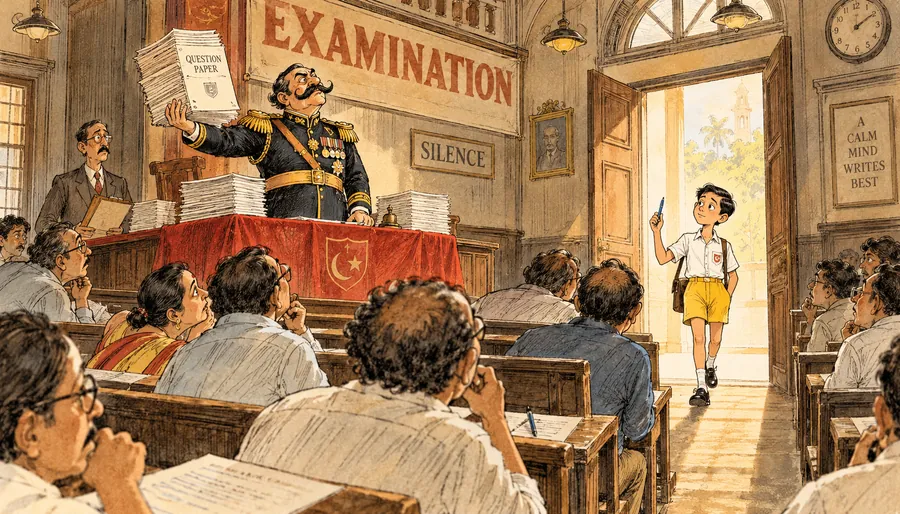
Yellow yellow, dirty fellow, sitting on a buffalo.
The greatest riddle one can encounter is this: how is it that the first rhyme the students of Crescent High School, Pune, manage to learn is "yellow yellow", when the rhyme is making a mockery of themselves?

The DNA of Crescent
Aimto draw the structure of a Crescentian
Alternating Yellow (P) and White (S) form the basic backbone of the DNA of Crescent, and the connecting rungs of the ladder are made by Black (T), Navy Blue (A), Brown (C) and Green (G).
Yellow (P)White (S)Black (T)Navy Blue (A)Brown (C)Green (G)
For the commerce sectionP and S: the phosphate–sugar backbone. A, T, C, G: the four bases. In real DNA, A pairs with T and C with G.
The Tie
Aimto explain a tie in one of the hottest parts of the country
Now, Brown is the new base, introduced in the alternating form of the TIE. Yes: in one of the hottest parts of the country, students are made to wear a TIE. Why? Never logically explained to anyone.
And do remember, Crescent is an adaptive institution.
When it was first introduced, the TIE was a full-length tie. That meant students had an accessory to pass the time with: just take off the TIE and practise the great ART of the single knot, the triple knot, the samosa…
It also meant that when a student was TIeRED of sitting in class, all he had to do was undo the knot of his TIE, ensure censure from the teacher, and possibly earn a walk out of the class to fix the knot. You could see the corridors of Crescent filled with students just TIE-ing their TIEs…

The Readymade Tie
Aimto observe what adaptation does to a species
But then Crescent adapted, and introduced the readymade tie. All you had to do was hook it around your neck, and it always remained a perfect triangle.
But paradoxically, it now means that Crescentians are a unique breed: they wear a TIE, but never know how to TIE a TIE.

Clown College
Aimto add one more colour and see what happens
The next part of the riddle: why a NAVY BLUE sweater?! Just imagine someone wearing YELLOW, WHITE, BLACK and BROWN, and then, to top it all, a NAVY BLUE sweater. Maybe we were not in school. We were in Clown College.
- Yellowshorts
- Whiteshirt
- Blackshoes
- Browntie
- Navy Bluesweater

Unity in Diversity
Aimto write a short note. [5]
The assorted colours chosen by Crescent perhaps reflect the mentality of a generation of India whose society was fractured, and in which everyone zealously tried to stitch the various identities together. After all, can anyone explain why "Unity in Diversity in India" was asked in the exams every year from the fifth standard to the tenth? And the 23rd wonder of the world is that students still struggle to write the answer in the Board exams…

Grey, Brown, Green
Aimto account for the walls and the boards
A few years back, the Grey Building of Crescent was recoloured a light brown, while a few buildings kept their green and light-yellow texture. And with green comes one more riddle: why did a few classrooms on the first floor have a Green Board, while the majority had Black Boards? Another unexplained riddle…
(poor paragraph, no relation between sentences, probably should change it, let it be why bother, who is going to see it anyways, who is going to complain anyways.. @@ poor color combination, no synergy between colors, probably should change it, _ _ _ _ @@)Pencil note in the margin · left as found
The Blazer
Aimto measure the irony
Now the biggest irony: where I thought a tie in summer was overkill, these days Crescentians have to go about in a navy blue BLAZER.

— Vinaay Patil
Observations
Crescent, in six colours
- First rhyme learntabout ourselves
- Tie in the Pune heatwhy?
- Crescentians who can tie a tie0
- Colour of the sweaternavy, somehow
- "Unity in Diversity" askedStd. V to X
- Board colour, first floorgreen, sometimes
- Today's uniform+ a blazer
Riddles: 6Explained: 0
Result: unexplainedDays Under the Crescent Sun
Stories from school days and a 1990s Pune childhood: plans that were too clever, teachers who were never questioned, and the people who made it all bearable. Also about those pokingly yellow shorts: Board de Merite.
More from the series →