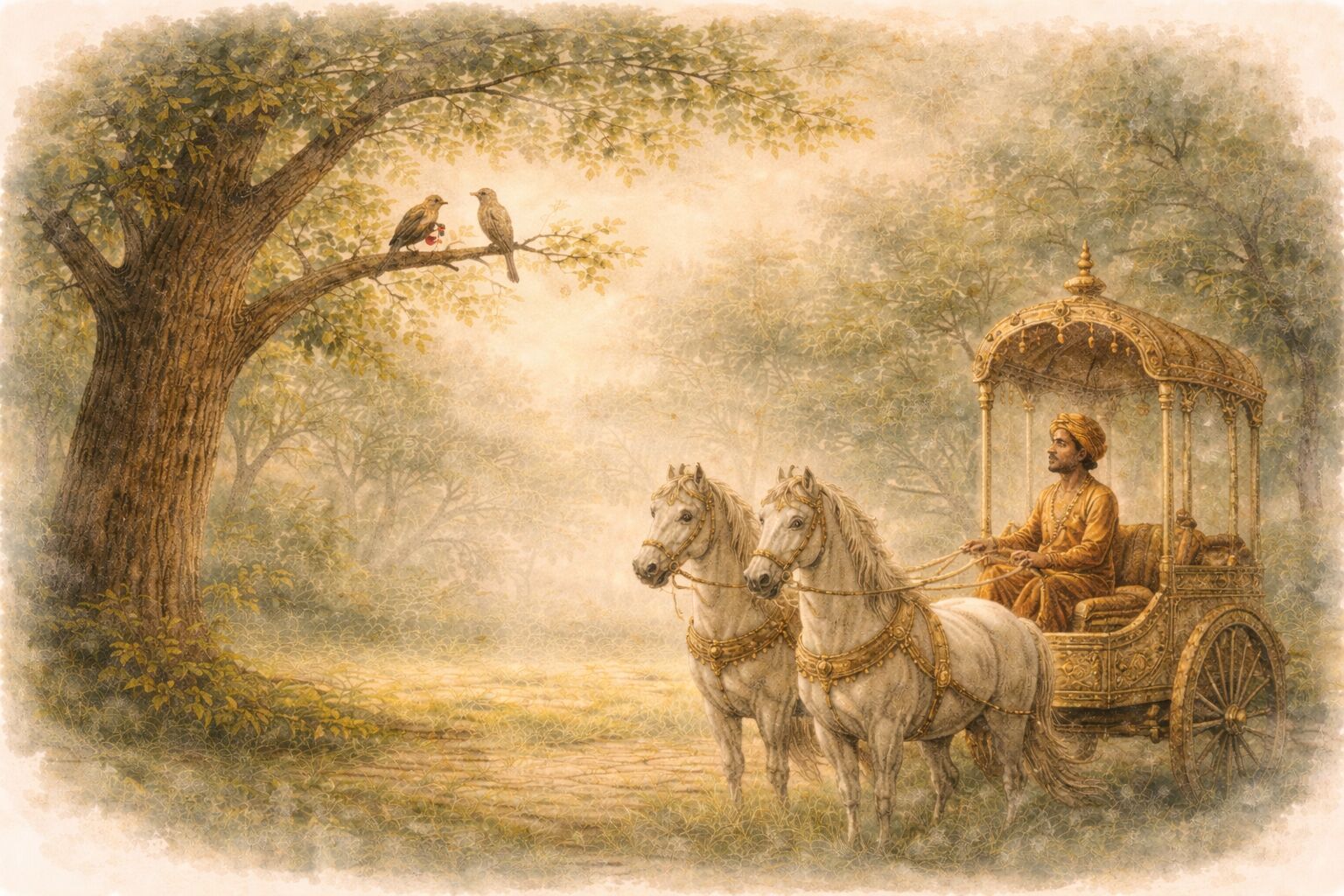
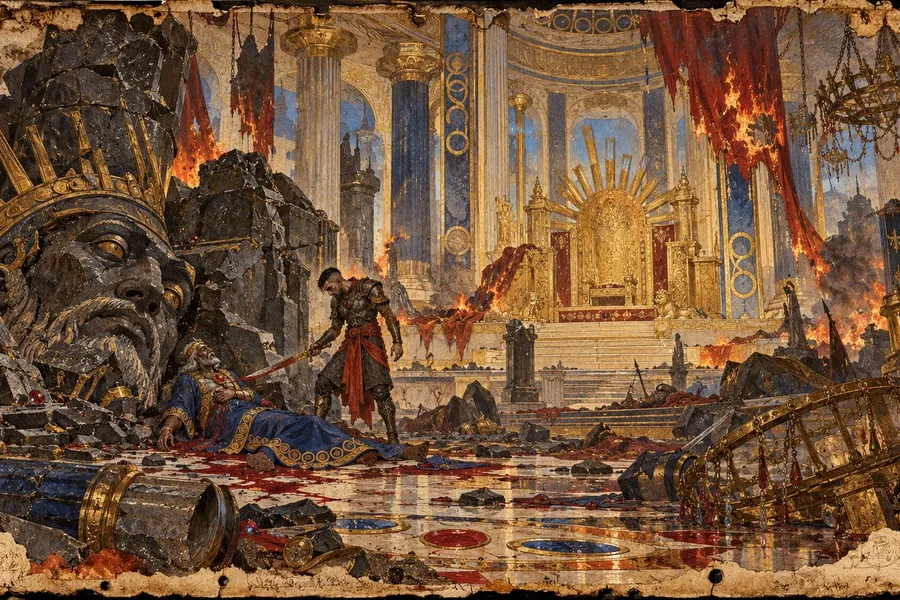
Two birds on one branch, and a rider in his chariot: the two pictures Death draws for a boy at his door.
The fire takes
Offered to Death
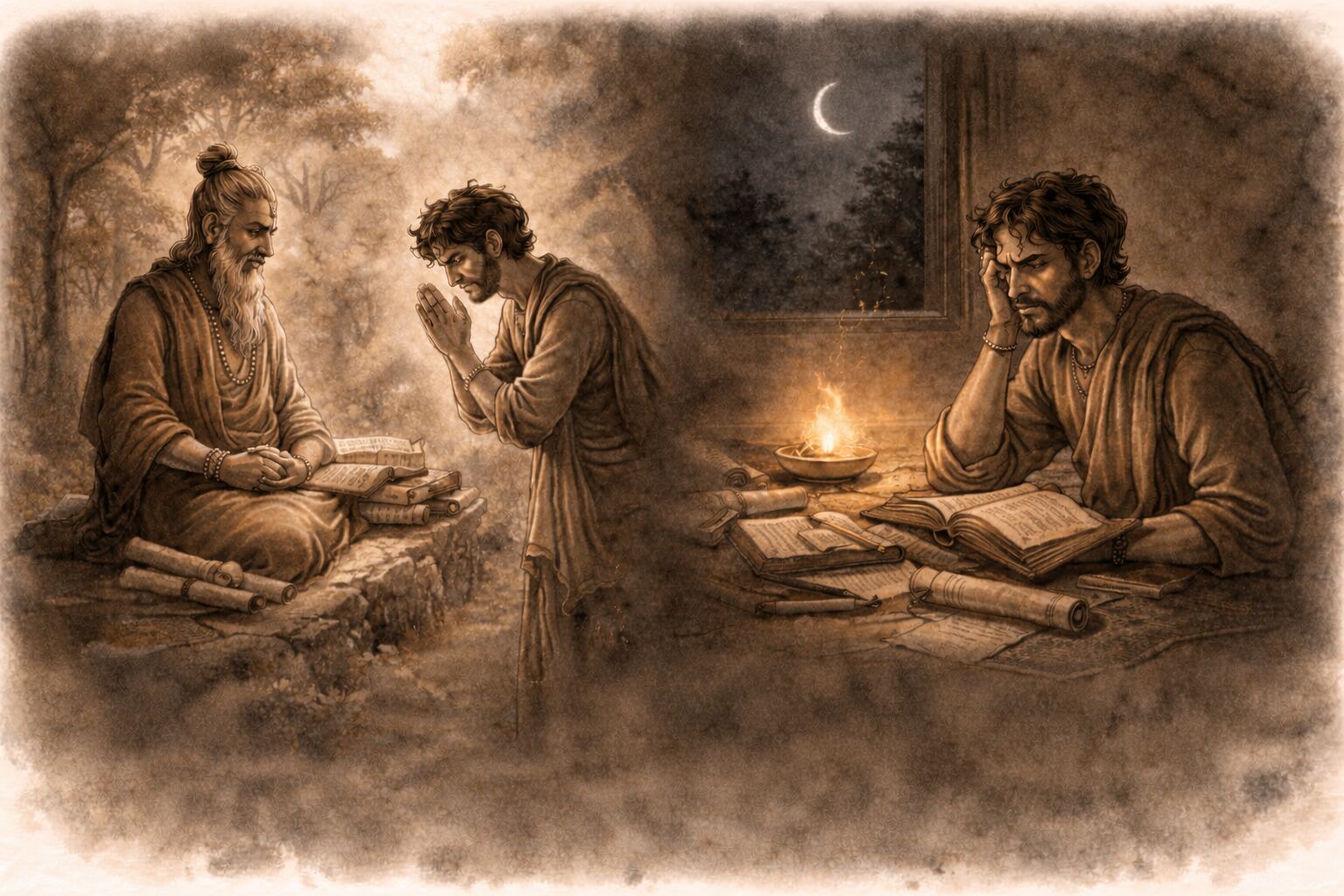
Long ago, there lived a young boy named Nachiketa. Though only a child, he had an unusually curious mind, one always full of questions.
One day, his father Uddālaka was performing a grand ritual. Cows and other animals, old and long past their use, were being given away as offerings. The chants were precise and the fire steady, yet something felt unsettled.
Nachiketa stood near his father as the ritual continued. He watched for a while without speaking. Then he turned to his father and asked, “Father, to whom are these gifts being offered?”
Uddālaka went on with the ritual and did not reply.
Nachiketa’s gaze followed the offerings into the fire. He had often heard his father speak about intention: that the quality of a gift mattered more than its appearance, and that the sincerity behind it mattered most.
Then he asked again, gently, “Father, will these offerings truly bring the fruit you seek?”
This time his father glanced at him, irritation beginning to show. Nachiketa fell silent.
But the thought had already taken shape. If everything is being given, if nothing remains, what about me?
For a moment he simply watched the fire consume what was placed upon it. Then, as the thought fully formed, he asked, softly and without accusation, “Father… when you give away everything, will you give me away too?”
There was a brief pause. The fire crackled. Then, almost to himself, Nachiketa added, “I wonder… to which god will I be offered?”
Already irritated, his father turned sharply and said words he did not fully weigh:
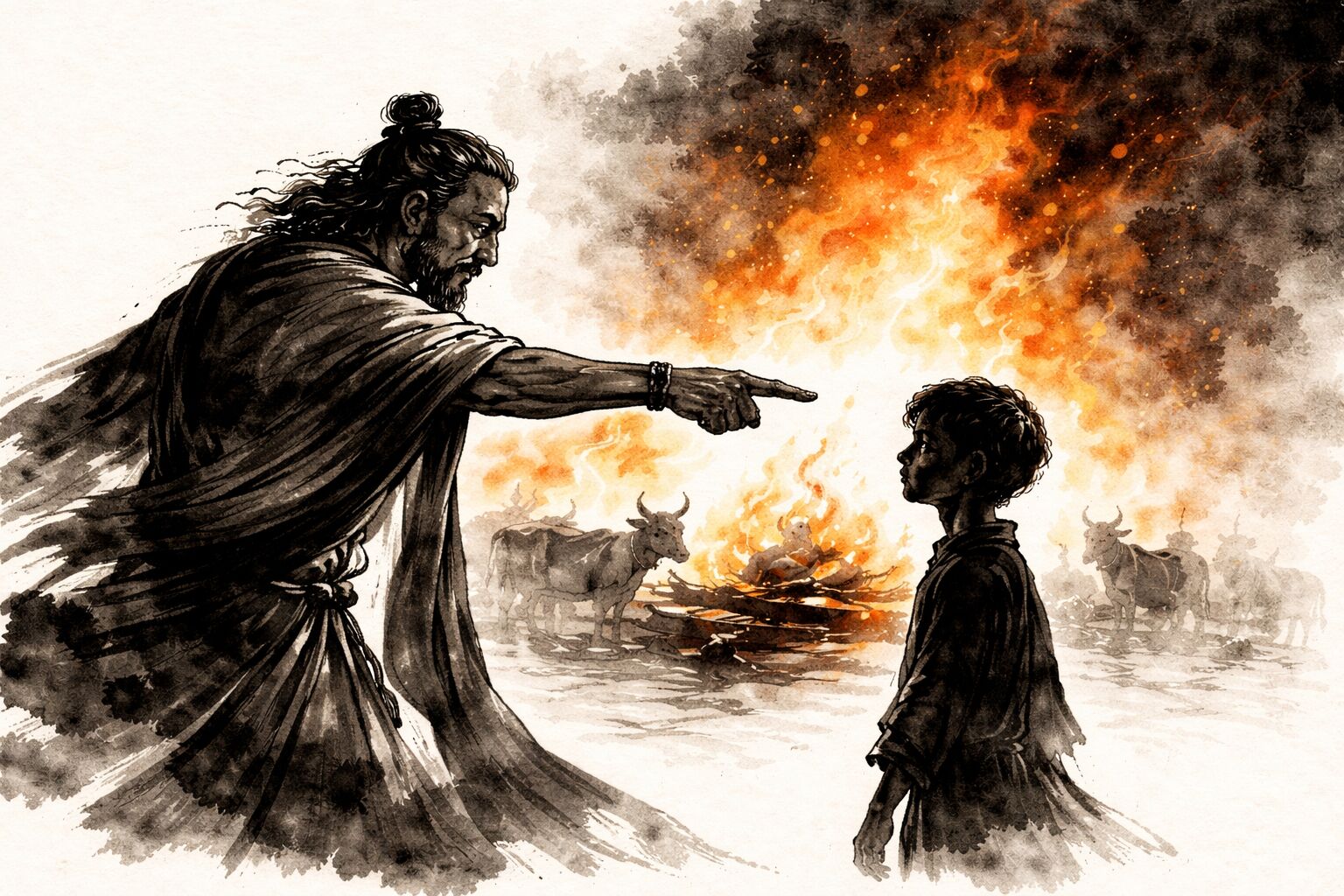
“I will give you to Death.”
The words hung in the air. The crackle of the fire was the only reply.
“I will give you to Death.” Words a father did not fully weigh.
Nachiketa was shocked, but he did not cry. He did not argue. Yet something inside him caught fire. What did my father truly mean? What is death? If death comes, what remains?
He stood quietly for a long moment. Then he bowed to his father, turned, and began his journey to the house of Yama, the Lord of Death.
Three days at the door
The Guest at Death’s Door
When Nachiketa arrived, Yama was out on his duties and the house was empty.
Still, he waited.
One day passed. Then another. Then a third.
No food. No water. No complaint.
When Yama finally returned, he was startled to find a young boy sitting calmly at his door. A small fire burned beside the threshold, its embers steady in the evening air. Yama paused near it before speaking, and the boy rose as he approached.
“Who are you?” Yama asked.
“I am Nachiketa,” the boy replied simply.
Three days, no food, no water, no complaint. Then the Lord of Death came home.
Yama looked closely at him: the steady eyes, the quiet posture, the unshaken presence.
“Your time has not yet come, my child. Only when it does shall I come to you.” Yama spoke with as much gentleness as he could summon. “But you have waited three days at my door,” he added. “For each day you waited, I grant you a boon. Ask your first wish.”
Nachiketa did not answer at once.
“You are not in a hurry,” Yama observed.
“I have already waited,” Nachiketa said.
Yama smiled faintly.
“For my first wish,” Nachiketa said, “may my father’s anger be calmed. May he recognise me with love when I return.”
Yama nodded. “You think first of peace,” he said. “So be it. Uddālaka will sleep without anxiety. His heart will soften, and he will welcome you home.”
Nachiketa bowed. For a moment he remained still. The weight he had carried since leaving home eased, just slightly. The image of his father, no longer angry, no longer restless, passed through his mind.
“You may ask your second wish,” Yama said.
The second boon
The Second Boon
Nachiketa’s gaze drifted towards the embers.
“My first wish was for peace at home,” he said slowly. “But even when the home is at rest, the mind does not always follow. For three days my thoughts circled the anger I had stirred in my father. And even now I wonder: what if I cause him anguish again?”
The child had spoken without defence. Even Yama, who had watched countless lives cross his threshold, felt a rare stillness in the presence of the boy.
Then Nachiketa said, “Teach me the fire that leads beyond worry, fear and sorrow.”
Yama did not answer at once. He let the weight of the question settle.
“Many ask for this fire,” Yama said at last, “but few know why they ask. Fewer still understand what to do with the answer.”
Nachiketa met his gaze. “I do not want fear to decide my actions,” he said. “And I do not want worry to rise before I speak, before I act, before I question.”
Yama understood what the boy truly sought: not rituals, but freedom from the uneasy trembling of the mind.
He inclined his head. “Worry is born,” he said, “when the mind mistakes the passing for the permanent.”
He continued, calm and deliberate: “The mind runs outward, chasing sounds, forms and thoughts. When it clings, fear follows. When it resists loss, worry is born.”
Then Yama spoke words that echo through the Upanishads:
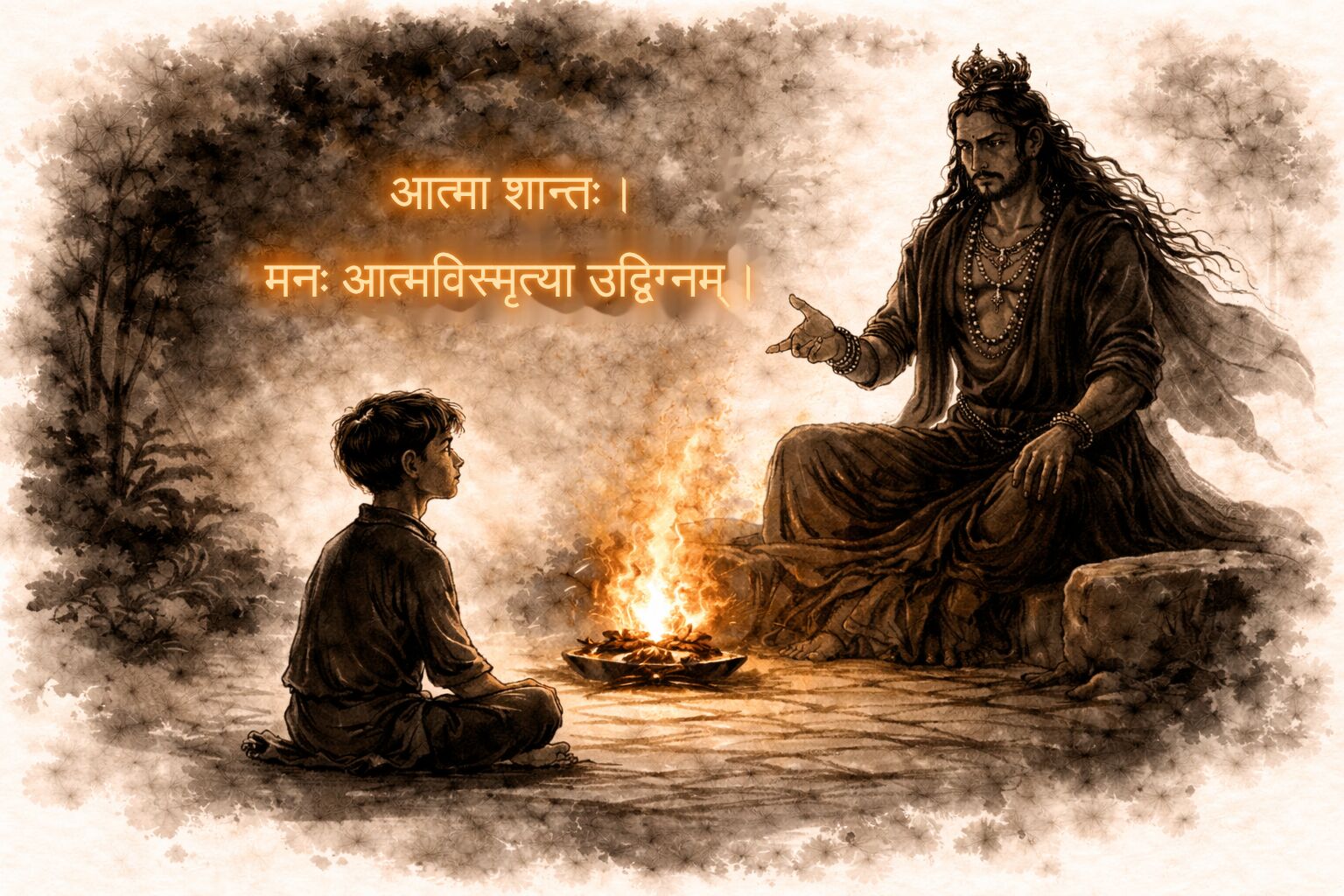
आत्मा शान्तः । मनः आत्मविस्मृत्या उद्विग्नम् ॥
The Self is never anxious. The mind is anxious because it forgets the Self.
आत्मा शान्तः। The Self is never anxious.
Nachiketa listened. Yet his expression remained uncertain.
Yama saw it. Understanding had not yet ripened into clarity. So he continued: “Know the Self as the lord of the chariot, the body as the chariot, the intellect as the charioteer, and the mind as the reins.”
“When the reins are loose,” Yama said, “the horses, the senses, run wild. The chariot veers and crashes. This is worry. When the reins are held steadily by understanding, the journey is smooth.”
Then Yama added, more softly:
“Worry is not caused by life. It is caused by a mind that has forgotten its rider.”Yama, at the threshold
Something shifted in Nachiketa. “I worry,” he said slowly, “because I live as the reins… not as the rider.”
The Self as the lord of the chariot, the mind as the reins, the senses as the horses.
Yama smiled. “When the mind rests in the Self,” he said, “worry finds no place to sit.”
Then Nachiketa asked the question that trembles at the root of all seeking: “How do I become the rider?”
Before Yama could reply, many questions rose in Nachiketa all at once. “Are there rituals that can make my mind stronger? Are there disciplines that remove doubt? How may this be understood fully?”
Yama raised his hand. “Enough, Nachiketa,” he said, not unkindly. “You are now worrying about worry.”
The boy fell silent. A faint smile touched Yama’s face. “Your eagerness reminds me of another seeker, Satyakama. He carried the same fire of curiosity.”
Nachiketa bowed, steadying himself. “Who is this Satyakama, my Lord?” he asked softly. “And did he find his way?”
Yama looked into the fire. “Yes,” he said. “There was one named Satyakama. Listen.”
A story within the story
Yama’s tale
Satyakama, the Seeker Who Could Not Rest
In a forest near a flowing river lived a man called Satyakama. He was diligent, kind and respected, yet his mind knew no rest.
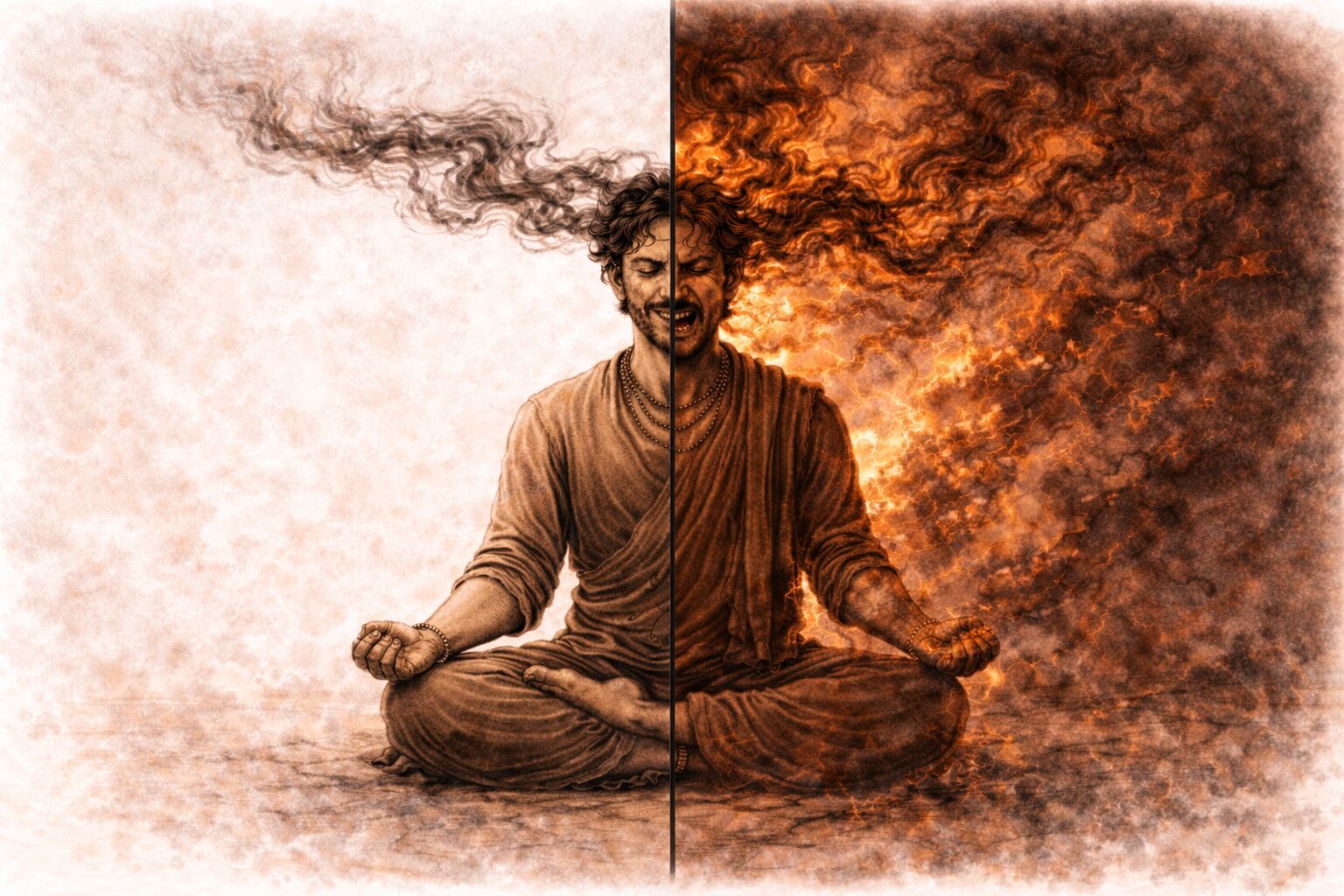
If he succeeded, he feared losing what he had gained. If he failed, he feared what might come next. Even in moments of stillness, a quiet whisper stirred within him: What if things go wrong?
At last, unable to bear this ceaseless unease, he left his home in search of an answer.
The first lesson
The Restless Mind Beneath Busy Hands
Yama continued.
Satyakama came upon a ritual priest and asked, “How may I end this fear that follows me wherever I go?”
The priest replied, “Perform your duties with greater diligence. Keep the hands engaged. When the hands are busy, worry fades.”
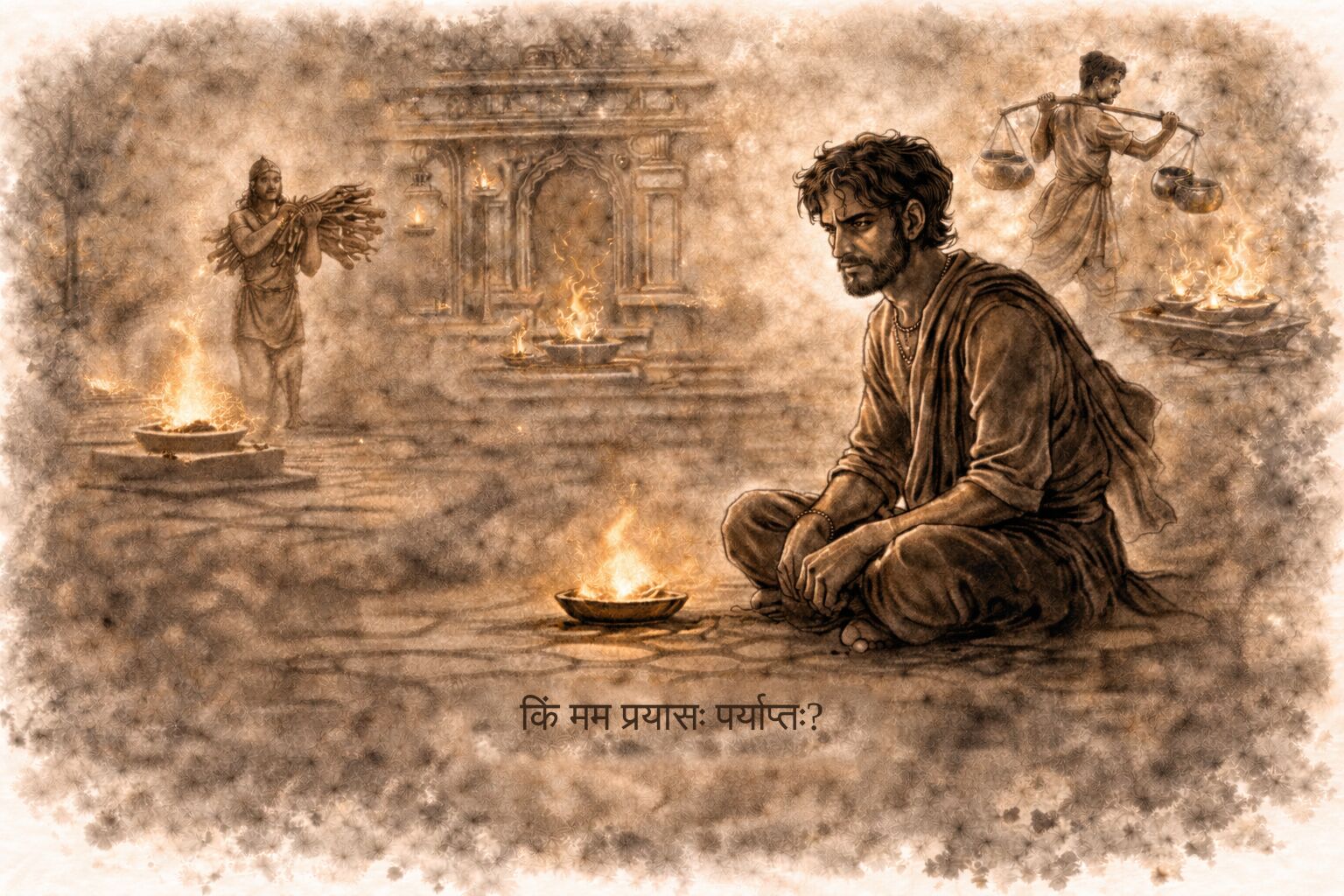
Satyakama followed this counsel. For many months he laboured: in ritual, in charity, in discipline. At first his mind grew lighter. But soon another question rose: Am I doing enough?
Satyakama began to see: action had altered the shape of his worry, but not its root.
किं मम प्रयासः पर्याप्तः? Am I doing enough?
The second lesson
The Burden of Knowing
Yama continued.
Satyakama went deeper into the forest in search of a wiser guide. There he found a learned scholar. Satyakama bowed and asked, “How may I end the worry that does not leave me?”
The scholar replied, “Worry arises from ignorance. Study deeply. Understand fully.”
So Satyakama immersed himself in scripture, logic and philosophy. His intellect grew sharp. His arguments became precise.
During the day, he felt confident. But at night another whisper returned: What if my understanding is incomplete?
Now his worry had changed its form. He no longer feared failure. He feared that his knowledge was not enough.
Satyakama began to see: knowledge had strengthened his mind, but it had not quieted it.
Confident by day; by night, the whisper returns.
The third lesson
The Mind That Resisted Control
During his time with the scholar, Satyakama’s knowledge increased. Peace did not. At last he bowed, departed and travelled deeper still.
There he met a yogi who spoke little and demanded much. “Restrain the mind,” the yogi said. “Force it into silence.”
Satyakama obeyed. He disciplined the body. He withdrew the senses. He held the mind in stillness.
For a few moments, it yielded. But the instant his effort slackened, thoughts returned, sharper than before. What he had pressed down rose again with greater force.
Satyakama began to understand: what is suppressed is not dissolved. Worry buried is worry strengthened.
बलनिग्रहात् न शान्तिः ।
Peace does not arise from forceful restraint.
Pressed down, the fire only rises again.
The watching bird
The Old Sage by the Tree
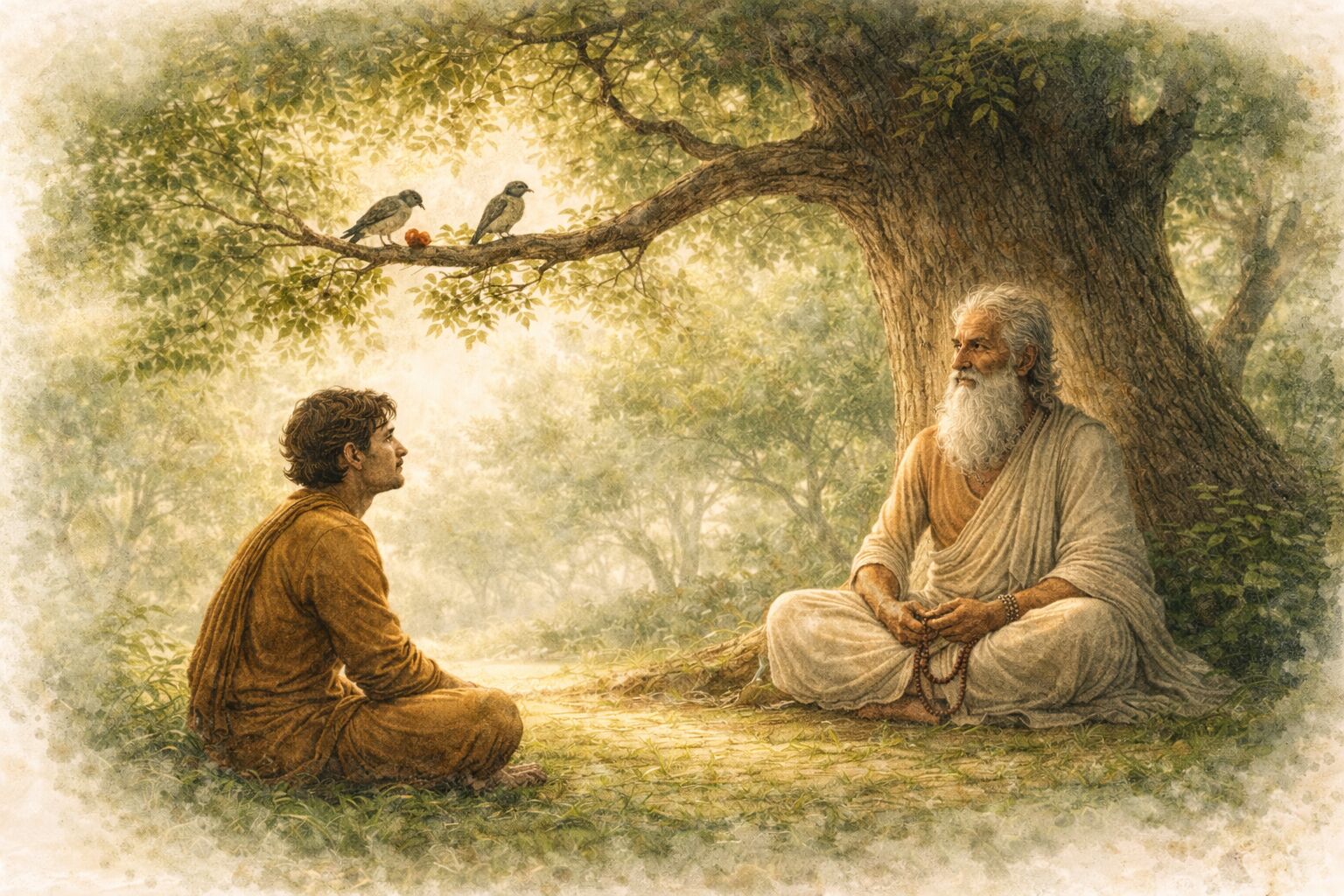
Exhausted, Satyakama sat beneath a great tree. Nearby, an old sage was watching two birds resting on the same branch. One bird hopped restlessly, pecking at fruits, sweet and bitter alike. The other remained still, observing.
The sage asked gently, “Which bird are you?”
Satyakama answered without pause: “The one that eats… and worries about the taste.”
The sage smiled. “Both birds are you. The eating bird is the mind, chasing experience. The watching bird is the Self, untouched.”
He paused. “Worry begins when you forget the watcher and live only as the eater.”
“Which bird are you?”
Satyakama returned to his life. He worked, but no longer carried the weight. He thought, but did not drown in thought. Worry still appeared. But it no longer lingered.
A steadier fire
Nachiketa looked into the fire. “Like a bird that flies,” he said softly, “but always returns to its branch.”
When the wandering one turns inward and recognises the one who sees, sorrow no longer remains.
Mundaka Upanishad 3.1.1–2
Just as dawn was about to break, Yama spoke. “Nachiketa, I must attend to my duties. Sit here and ponder what you have learnt. I shall return in a day. Until then, think about your third wish.”
For the first time since arriving at the threshold, no question rose in Nachiketa’s mind.
The fire still burned. The world remained as it was. Yet something within him had shifted. The flame at Yama’s door continued to glow, but within Nachiketa a steadier fire had been lit.
He bowed, not in fear but in recognition. And when he nodded, it was not with certainty, but with steadiness.
The mind would wander. But he now knew where to return.