A ledger that never closes in one life, and a wheel that keeps turning.
By Dagadu D
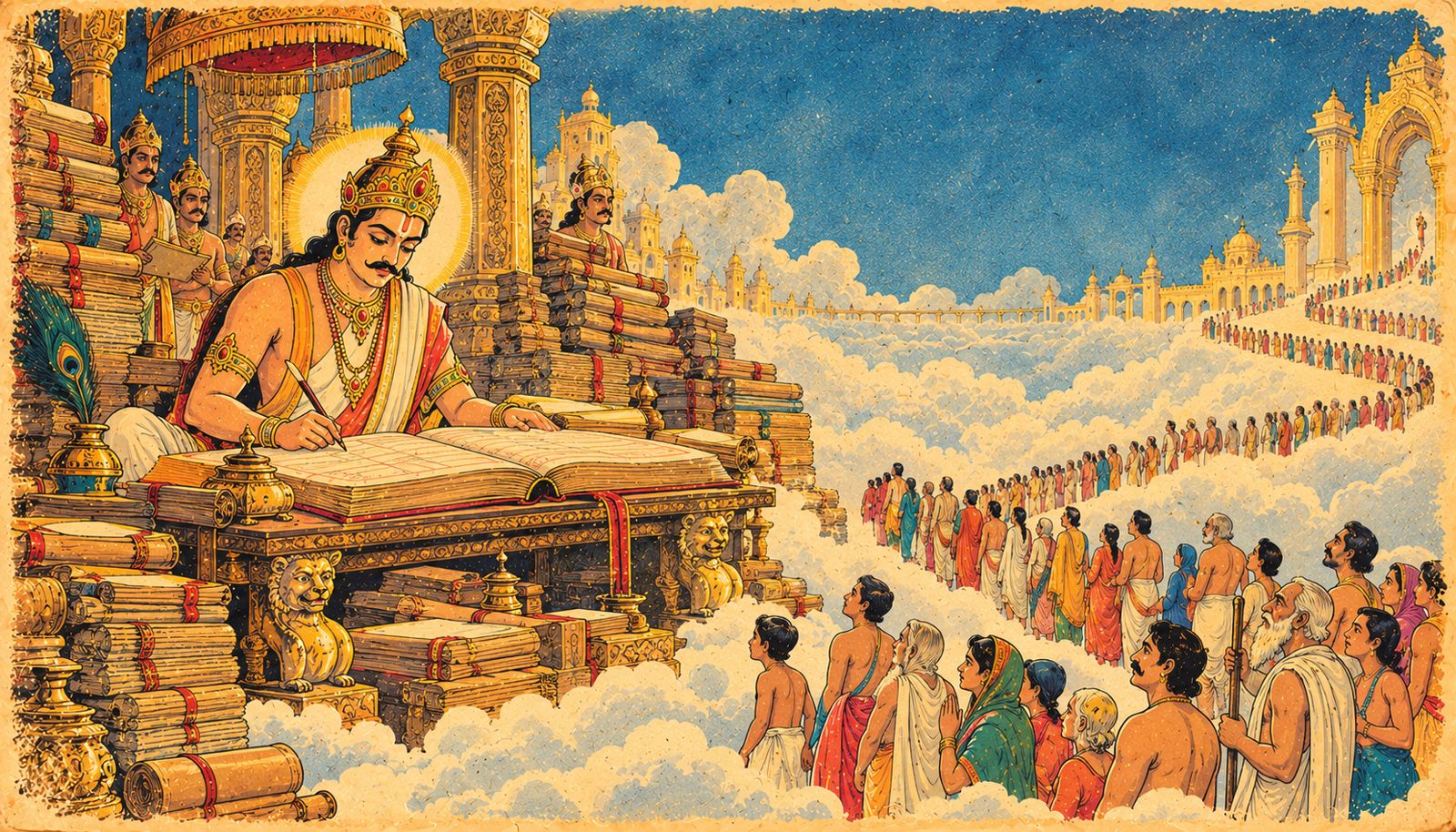
Chitragupt keeps the books. An endless line of souls waits for its accounts to be read.
India is a truly strange land. To claim you understand it, or even that you are beginning to understand a little of it, would be a very bold statement. I don’t remember who said it, but they described it precisely: “Anything you say about India, the opposite is also true.” That is based on modern experience. Add a continuous cultural existence of over nine thousand years, and it becomes far too much to take in within one lifetime. One would expect us to be aware of the sheer collective wisdom it has accumulated, but the exact opposite is true. Despite India being an ancient civilisation, we hardly know the meaning of the principles and ideas that India introduced to the world.
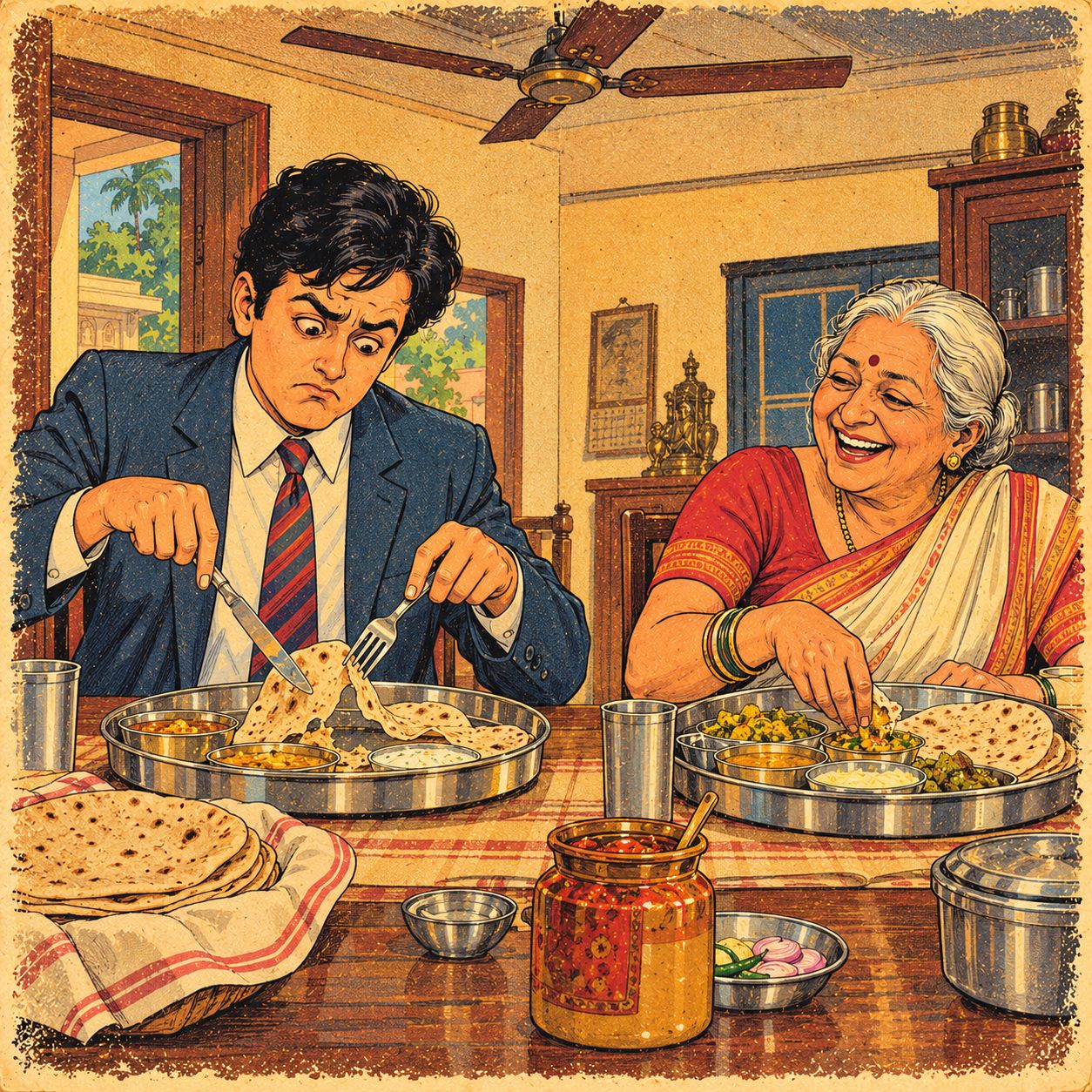
Much of our own philosophy travelled to the West and came back to us painted in Abrahamic colours. We learn our own philosophy through Western logic, which will never lead to realisation. Think of it as eating roti with a fork or chopsticks, and then wondering why anyone would invent a food so hard to eat with a fork. As logical as logic sounds, it can neither help nor lead one on the path of liberation. For the last thousand years, generations have accepted the dominance of logic and tried to understand core Vedic philosophy through its lens, struggling and stumbling and getting nowhere. Perhaps Einstein’s logic comes in handy here: one should not expect a different result by doing the same thing over and over again.
Our own philosophy, eaten with someone else’s cutlery.
Justice weighs
Take two logical concepts we all hold dear: Justice and Equality. Have you ever thought about what these values are? What do they even mean? Justice is a vague, abstract idea. Is it Justice to imprison a thief for ten years for stealing a kilogram of gold? Is a life sentence for murder Justice? Or is forgiving the thief or the murderer acceptable? What is the basic understanding beneath all this?
Hammurabi wrote “an eye for an eye, a tooth for a tooth” into law, intending it as a sense of Justice. From it arose the idea of punishment as the way to serve Justice. This works when a crime, as defined by society, has occurred. Punishment, in turn, gives rise to the idea of forgiveness, and many debates have sprung from the see-saw between the two. But this sense of Justice is limited to humanity. What about Justice in the animal kingdom? There, simple suffering is the only grievance.
Who holds the scales?
Vedic philosophy stays with this: all there is, is suffering. There is no such thing as Justice. Look at what the Pandavas went through to establish Dharma. For all their perceived good deeds, they lost their children. Ram destroyed Ravan, the villain of all the worlds, ushered in Ram Rajya, and still suffered a painful separation from his wife. Where is the Justice?
Vedic philosophy never uses the concept of Justice. Justice needs an ever-present almighty: a God, or a doctrine, to impart it, to define what is wrong and what is right. The Vedas never go down the path of declaring anything right or wrong. Instead, they arrive at a far more complex concept: Karma.
Our generation confuses Karma with Justice, as if Karma were some entity assigned the duty of settling scores. In everyday speech this entity even has a form, as in “Karma is a bitch.”
In its Vedic roots, Karma is never Justice.
The scales break
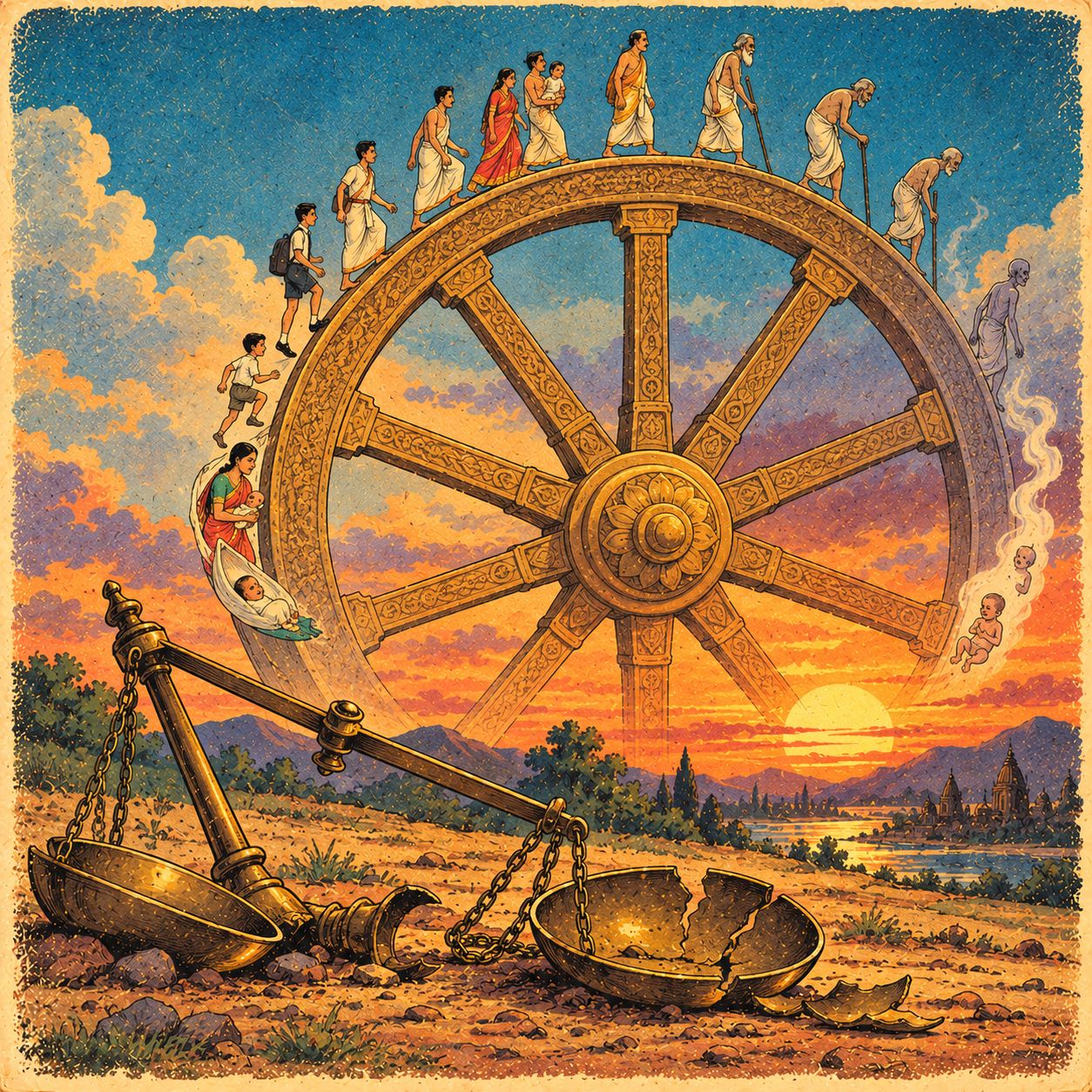
Justice weighs. Karma turns.
This misconception has led us to believe that Chitragupt dispenses Justice to souls by sending them to Hell or Heaven. That oversimplification is steeped in Western thought. At its core, Chitragupt is best described as an accountant: a bookkeeper who tracks each person’s karmic balance sheet. If the credits and debits net to zero, the soul’s Karma is balanced and it is fit for liberation. If there is any imbalance, the soul must go through another cycle of birth and death.
And here is a prime example of how deceptive Karma is. Even when we simplify it into a balance sheet, we fail to grasp its complexity. A lay mind immediately assumes that any debt on the sheet simply needs repaying. Karma doesn’t work that way.
Karma turns
Here is a simple example. You give alms to a beggar. This act has two consequences. One, you have done a good deed. Two, the beggar is now indebted to you for your help. In time, you are rewarded for your good deed; perhaps you get the car you have long desired. Your good deed has been balanced by a reward, but your karmic balance sheet is still not zero. It will not reach zero until the beggar pays off the debt to you.
Chitragupt’s ledgerAccount: you · one act of alms
Entry
Debit
Credit
Alms given to a beggarA good deed, credited to you
1
Reward received: the carThe good deed, settled
1
The beggar’s debt to youOutstanding. You cannot collect it; only the beggar can pay it.
1
Balance carried forward
1
The alms example as Chitragupt might enter it. The reward clears the good deed, but the beggar’s debt stays on the books, so the account does not close in this life.
The coin has been given and the reward received, but the thread between them is still unpaid.
This example should widen your idea of Karma. Think of the multitudes of people you have interacted with. Every interaction has created Karma that needs balancing. By now you will have figured out that one life is not enough to reach balance. That is why rebirth and the philosophy of Karma go hand in hand.
Birth after birth
All Indian traditions, Hinduism, Jainism and Buddhism, grapple with Karma in their own ways. The wheel on our flag symbolises the karmic cycle of birth and rebirth. Each tradition has examined Karma from its own perspective. Can we say which one is right and which is wrong? Do we even have the capacity to make such a definitive statement? We don’t.
What is certain is this: none of the Indian traditions boxes Karma into a simple chain of action and consequence. None sees Karma as a mechanism of universal Justice. In a simple system of action and consequence, you control your good deeds, and perhaps your rewards for them. But, as in our example, who controls the beggar? When does the beggar pay off the debt?
Still turning
By now it should be clear that Karma is not simple, and any system that grows out of a belief in Karma is never straightforward. Understanding Karma takes many lifetimes.
So the next time someone advises you to perform a certain pooja to land your next job, be a little sceptical.