Fire, seven rounds, and the rebel who wrote the rules of marriage.
By Dagadu D
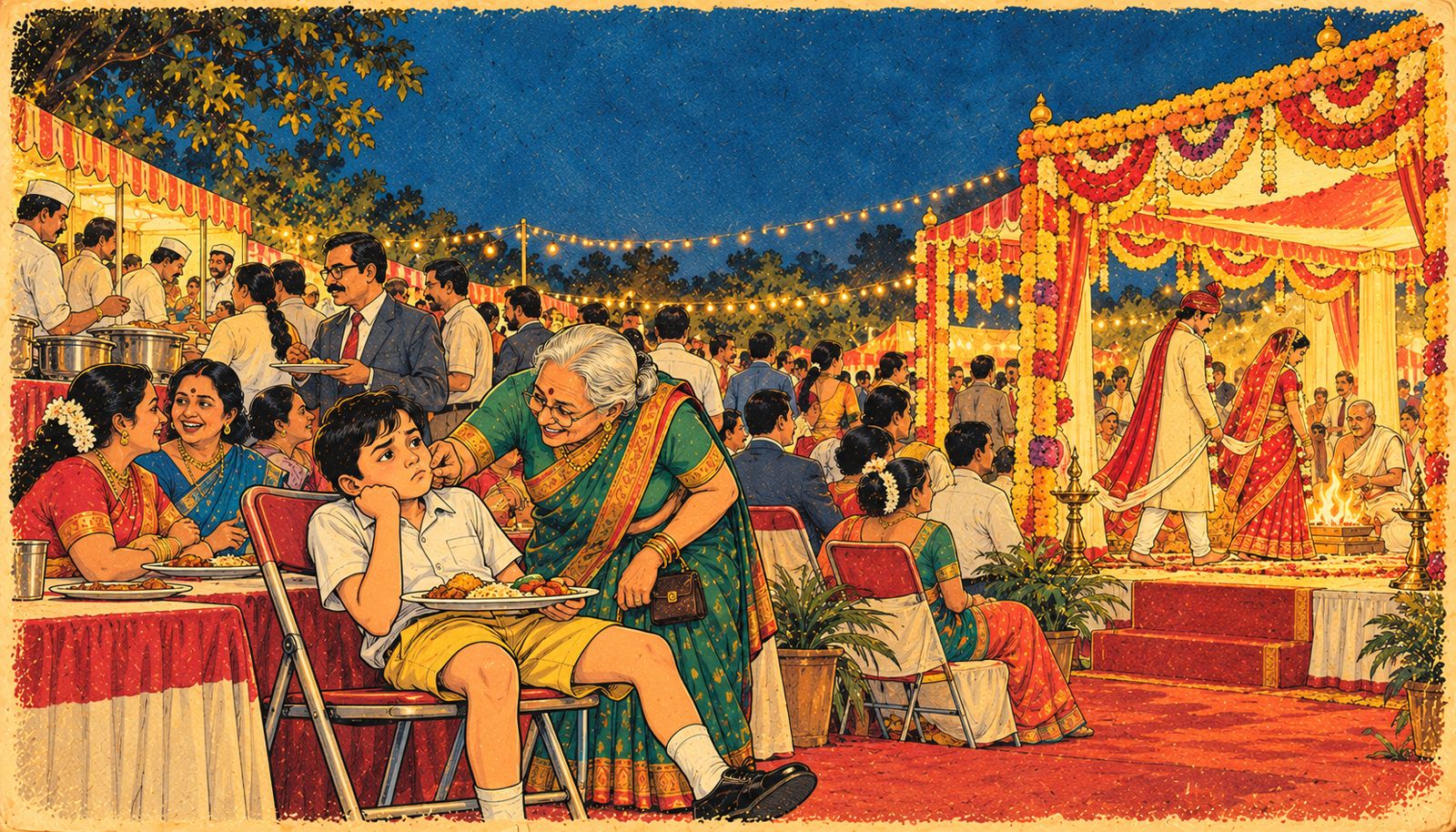
The wedding, the food queue, the granny, and the boy who wanted to know why.
I don’t know how many of you were dragged to your cousins’ weddings as children. I hated them more than anything. You attend a wedding where you know no one, simply because your presence is a must. I still don’t get it: why should a child attend a wedding where he doesn’t know the bride or the groom? Sitting on rickety chairs, handed a plate of food or something to keep you quiet, should not count as a marriage experience. But who am I to complain? Weddings seem to be designed to ignore the bride and groom and instead stroke the egos of some obscure Bua, Mama or Mami.
Sitting through twenty or thirty such weddings, never meeting the bride or groom but always leaving with a full belly, did have an effect on me. It made me ask: what the bleep is this marriage business? Why is it the focal point of one’s life, important enough to drag me away even during my board exams? The guests were more interested in the food queue than in the rituals; to them it was a mela, a chance to meet each other. Especially the wrinkled grannies who would ask the million-dollar question: “Remember me? I changed your nappies when you were three months old,” or “You cried for such-and-such when you were one.” I am not Abhimanyu, who learnt from inside his mother’s womb. Expecting anyone to remember their first two years is just... anyway. Instead of answering these grannies, I would ask, “Why do people get married?”
As you can guess, the answer was “You’ll know when you grow up.” Some said, “That’s the tradition.” Some called me rude outright. None cared to explain the why.
This question stayed unanswered for a very long time. And hidden at its root was another: what is marriage?
Phera 1 of 7
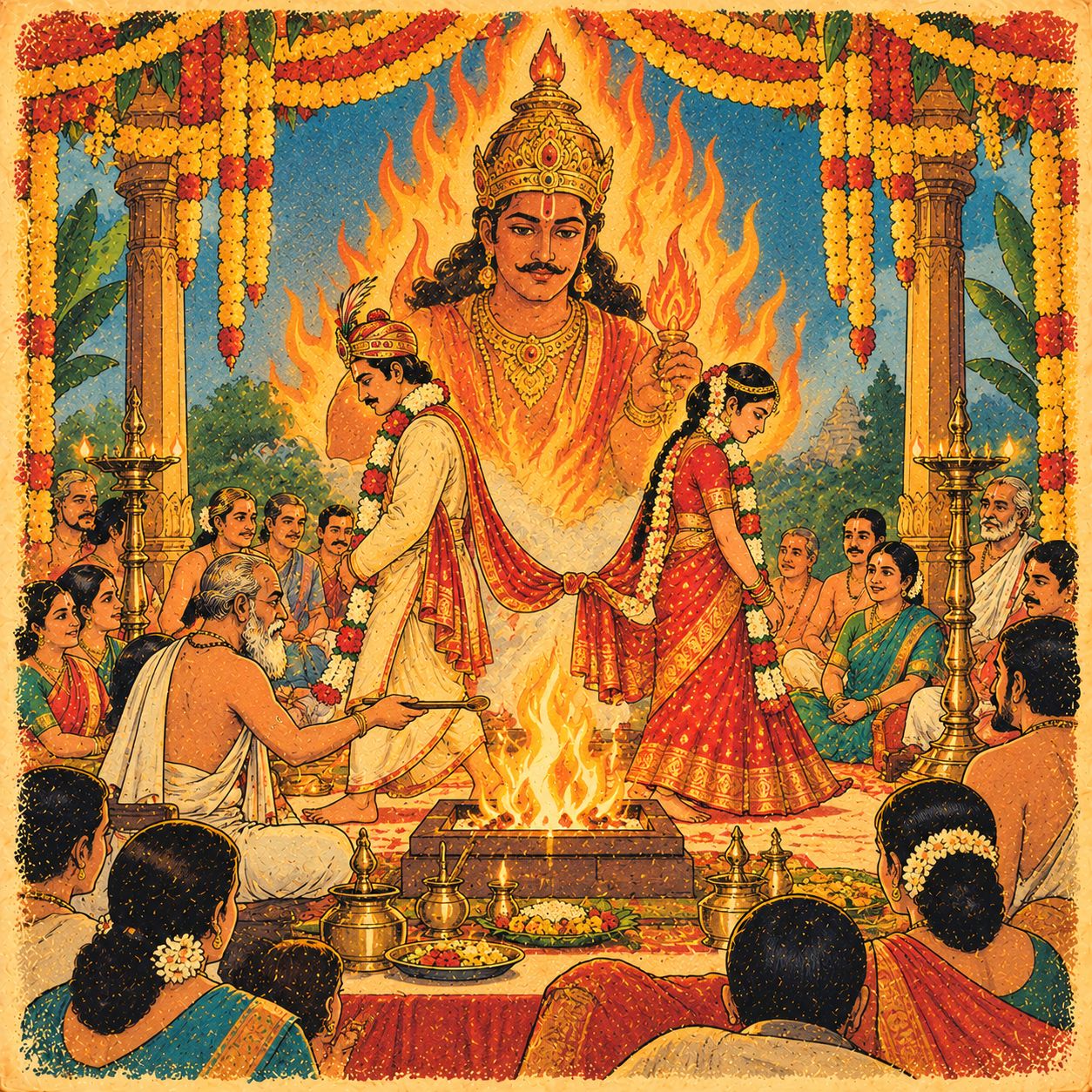
Every religion, or rather every culture, has some form of marriage. Its basic premise is marking one person for another, for eternity, say. The marking takes many forms: exchanging rings, taking vows, repeating certain words, and more. Even within India, weddings vary a great deal from north to south and east to west. The common thread is fire and the seven pheras, the exchange of vows with fire as the witness. Fire, Agni, has been one of the most important gods for a very long time. His duty is to carry our offerings to the gods. The Rigveda begins with a prayer to him, and almost every ritual connected to human life is performed in his presence. In its simplest form, lighting the daily diya is nothing but inviting his presence. For prayers to reach the almighty, Agni must be there. Agni can mean many different things; we will come to that a little later.
Agni, the witness at every wedding.
That explains why Agni presides over the seven pheras: the couple is registering their wishes and vows with God through Agni. Now I understood where the registration happens, but the question of marriage itself still eluded me.
Phera 2 of 7
Hinduism recognises eight types of marriage. They are not a menu of options to choose from; they are categories assigned after the event. The eight are:
१
Brahmaब्राह्म
The groom’s family formally asks the bride’s family for her hand. Once everyone agrees, the wedding is performed with kanyadaan.
२
Daivaदैव
The bride is offered as a kind of dakshina for services rendered. Here the bride’s father seeks out the groom. It differs from the Brahma marriage in that the woman is treated as an object.
३
Arshaआर्ष
The bride is married to a sage or Rishi. The bride’s father gives nothing to the groom and may even receive something, such as a cow.
४
Prajapatyaप्राजापत्य
Similar to the Brahma marriage, but with no expensive rituals; garlands are exchanged in the presence of the families, with their consent. It’s the money-saver package.
५
Gandharvaगान्धर्व
A simple form in which the bride and groom accept each other and exchange garlands, usually without their parents present, or against their wishes. No formal rituals, no parental approval.
६
Asuraआसुर
The bride’s father gives away his daughter in exchange for money, wealth or some other material gain, without her consent. The father may or may not be under duress.
७
Rakshasaराक्षस
Marriage by brute force, which may involve abduction or killing the bride’s family.
८
Paishachaपैशाच
The most atrocious form, in which the bride is raped, intoxicated or mentally disoriented before the marriage, often for revenge or to establish authority.
So the broad framework of marriage is clear. To put it even more simply, marriage is a declaration to society at large, on behalf of the bride and groom, that from now on these two individuals may have sex with each other, and that it will be considered fidelity.
Why do I boil all of marriage down to sex? Because sex is the basis of procreation, and here Agni enters again. Agni, the plain fire of the homa, can also be the burning desire to procreate. That fire is essential to consummating the marriage.
Our ancestors knew this very well, and knew how to veil it and sanctify it with rituals; they called it Vivah. But it was not always so. There was a time when marriage did not exist in any form, and neither did the eight categories. In my own burning desire for knowledge, I went looking for how it all began.
Phera 3 of 7
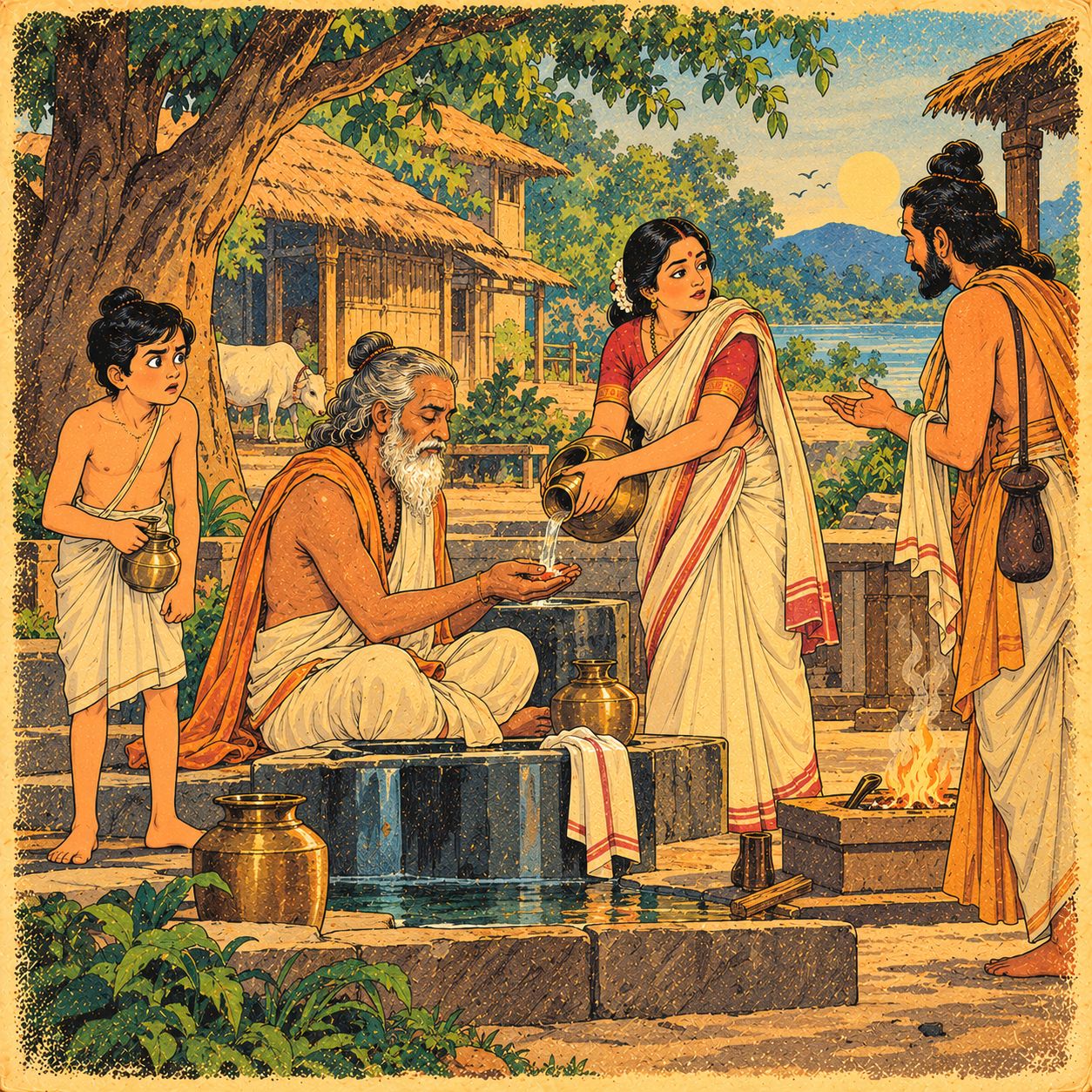
In the Chandogya Upanishad there is a story about marriage. Shvetaketu, the roughly ten-year-old son of the sage Uddalaka, is performing the morning ablutions with his father, helped by his mother. As his mother is handing water to Uddalaka, another Brahmin approaches her and asks her to lie with him. She readily agrees and goes with him. This angers Shvetaketu, and he asks his father how he can allow such a thing. His father replies, “Boy, this has been the rule since antiquity. I do not own her; she is free to decide what she wants.”
“I do not own her; she is free to decide what she wants.”Uddalaka, to his son
Uddalaka at his morning prayers, his wife, the stranger, and a son who will not forget.
Shvetaketu finds this unacceptable. It should not be so, he says; a woman cannot simply walk away. Later, Shvetaketu became a great ascetic and established fidelity between partners. He declared that a wife is not merely beloved to her husband; she must belong to him alone. The notion of the pativrata came into being. He designed the framework of marriage and decided what was moral and immoral within it.
Part Two · Phera 4 of 7
Part Two
Let’s go a bit Freud on Shvetaketu. Growing up in the ashram of the seer Uddalaka, he had a companion named Ashtavakra, who grew up to become one of the greatest sages. His works, such as the Ashtavakra Gita and the Ashtavakra Samhita, explore the nature of metaphysical existence and the meaning of individual freedom.
Ashtavakra’s own story is fascinating, and it has a Bollywood ring to it. Accounts of his birth vary slightly, but the accepted outline is this. His father, Kahoda, was a disciple of Uddalaka and later married Uddalaka’s daughter, Sujata. Once, Kahoda was reciting the Vedas with his pregnant wife beside him. He made a mistake, and the unborn child corrected him from the womb. This happened eight times, enough to anger Kahoda. Insulted by an unborn child, he cursed it to be born with eight deformities for its impudence towards its father. The baby was born bent in eight places, and so he was named Ashtavakra, the one with eight bends.
Later, Kahoda travelled to the court of a nearby kingdom for a debate and lost to his opponent, Vandin. Before the debate began, Vandin had set a condition: whoever lost to him would be drowned.
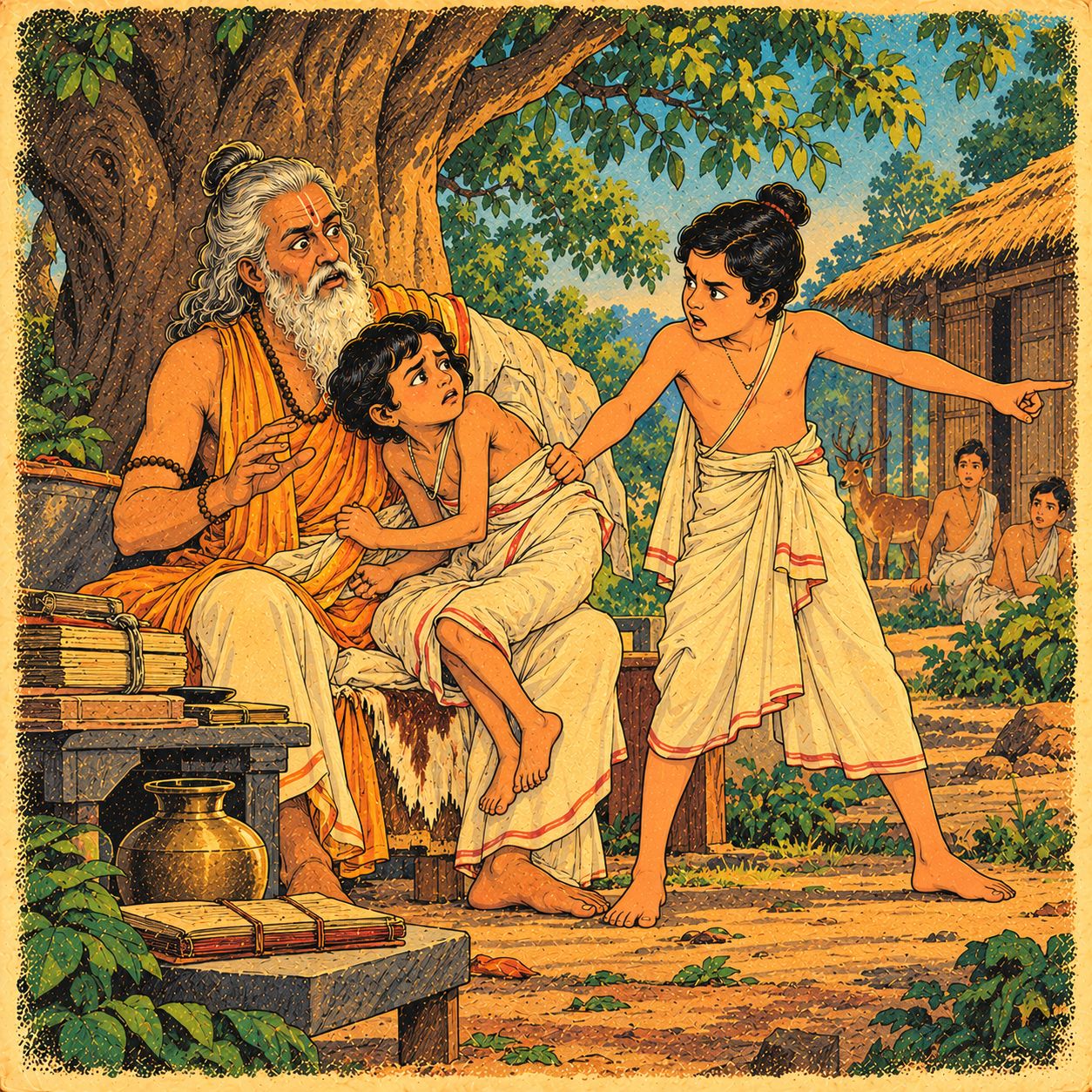
All this was kept from Ashtavakra, who grew up believing Uddalaka was his father. For years Ashtavakra and Shvetaketu were close friends, of similar age and growing up in the same household. One day, as Uddalaka was playing with the two boys, Ashtavakra climbed into his lap. Shvetaketu felt betrayed. He pulled Ashtavakra down and told him that Uddalaka was not his father. Uddalaka was shocked. To add salt to the wound, Shvetaketu told Ashtavakra that his real father had died after losing a shastrartha, a debate on the scriptures.
Two boys, one father, and the moment it broke.
Shocked and angry, Ashtavakra left, vowing to avenge his father’s death. Behind him he left a disturbed Uddalaka, angry with Shvetaketu. He had raised both boys as equals, and one had wounded the other. To make Shvetaketu realise what he had done, Uddalaka told him that he, too, was not Uddalaka’s own son: Shvetaketu was the son of one of his disciples. Ashtavakra and Shvetaketu were brothers not by birth, but by the love they shared for their father.
Flashback: Shvetaketu remembers the morning of his childhood when his mother walked away with a stranger. There was no “right to own” a woman, and this revelation shattered him. It was a blow to his identity, the first of many. (Would Freud call it bad parenting? Or blame the mother?)
Phera 5 of 7
Cut to: Shvetaketu has become a scholar, trained under Uddalaka, and the training has fed his pride; he is now a know-it-all. Sensing this, Uddalaka asks him whether he knows that which cannot be taught, cannot be seen, heard or understood. Shvetaketu admits that he knows no such thing. This sends him off on his next round of studies.
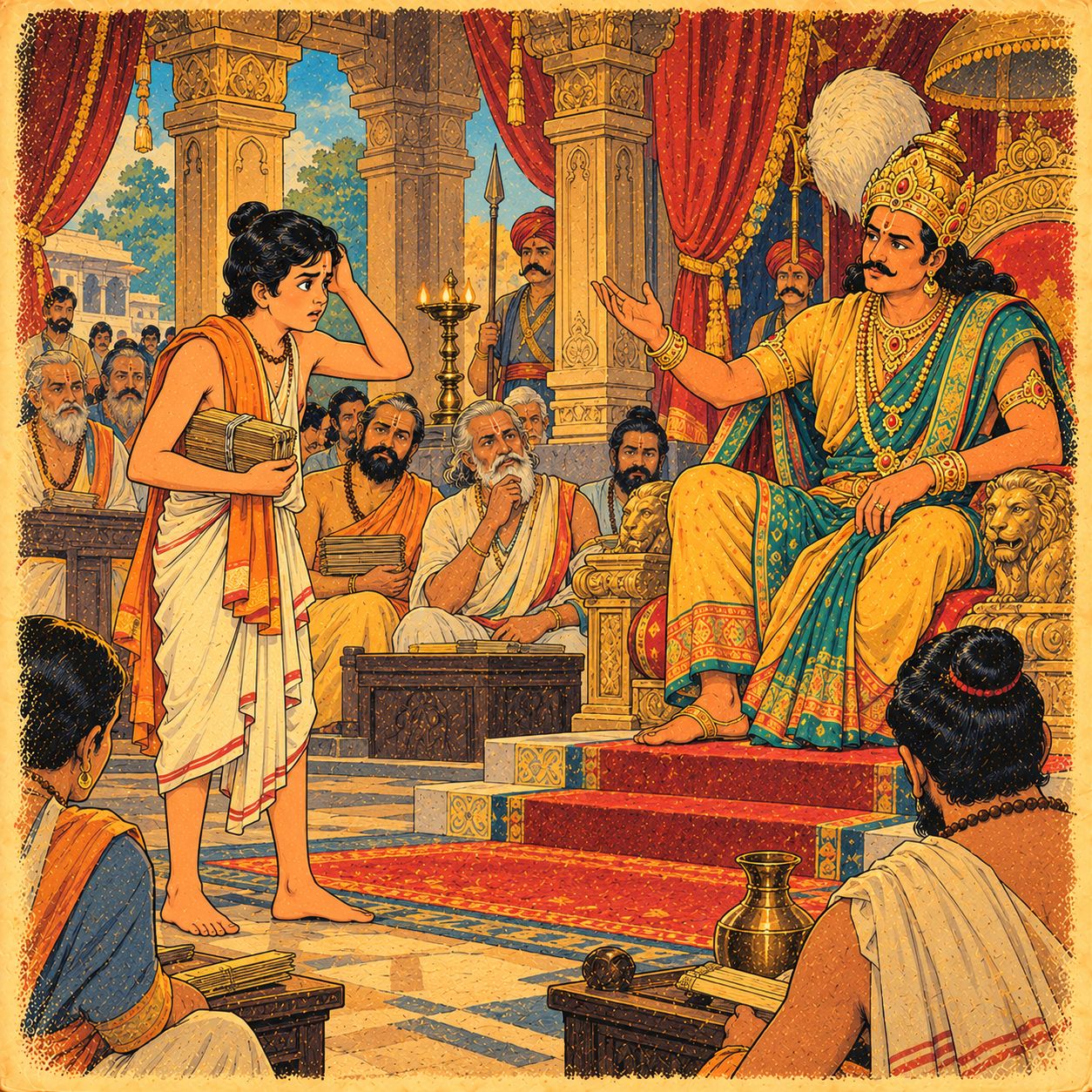
Cut to: Shvetaketu returns, armed with knowledge of what cannot be taught, and his father is pleased. He then goes to the court of King Pravahana of Panchala. The humble king asks him a few questions about, to keep the story short, what happens after death. Despite knowing what cannot be taught, Shvetaketu cannot answer. His pride takes another blow, and he returns to his father. Uddalaka admits that he does not know the answers either. In his ever-learning spirit, Uddalaka advises him to go back to King Pravahana and seek that knowledge. Shvetaketu, because of his ego, avoids it.
The scholar who knew what cannot be taught, silenced by a king’s simple question.
Phera 6 of 7
Cut to: a few years later, after the Mahabharata war, the unified kingdoms are appointing priests. One Rishi, Agnevsa, is appointed chief priest of Kosala, Kashi and Videha. Shvetaketu feels the position should have been his, given his family’s stature, his high birth and his sense of entitlement. He asks Uddalaka to use his connections to get him the post, and Uddalaka flatly refuses. This turns Shvetaketu against meritocracy and leads him into more trouble. He begins to object to drinking among Brahmins and to what he calls adultery. This, in turn, drives him to build a framework for what marriage should be: what counts as adultery, and what is sanctified within marriage. Shvetaketu pushes to ban polygamy and prescribes monogamy.
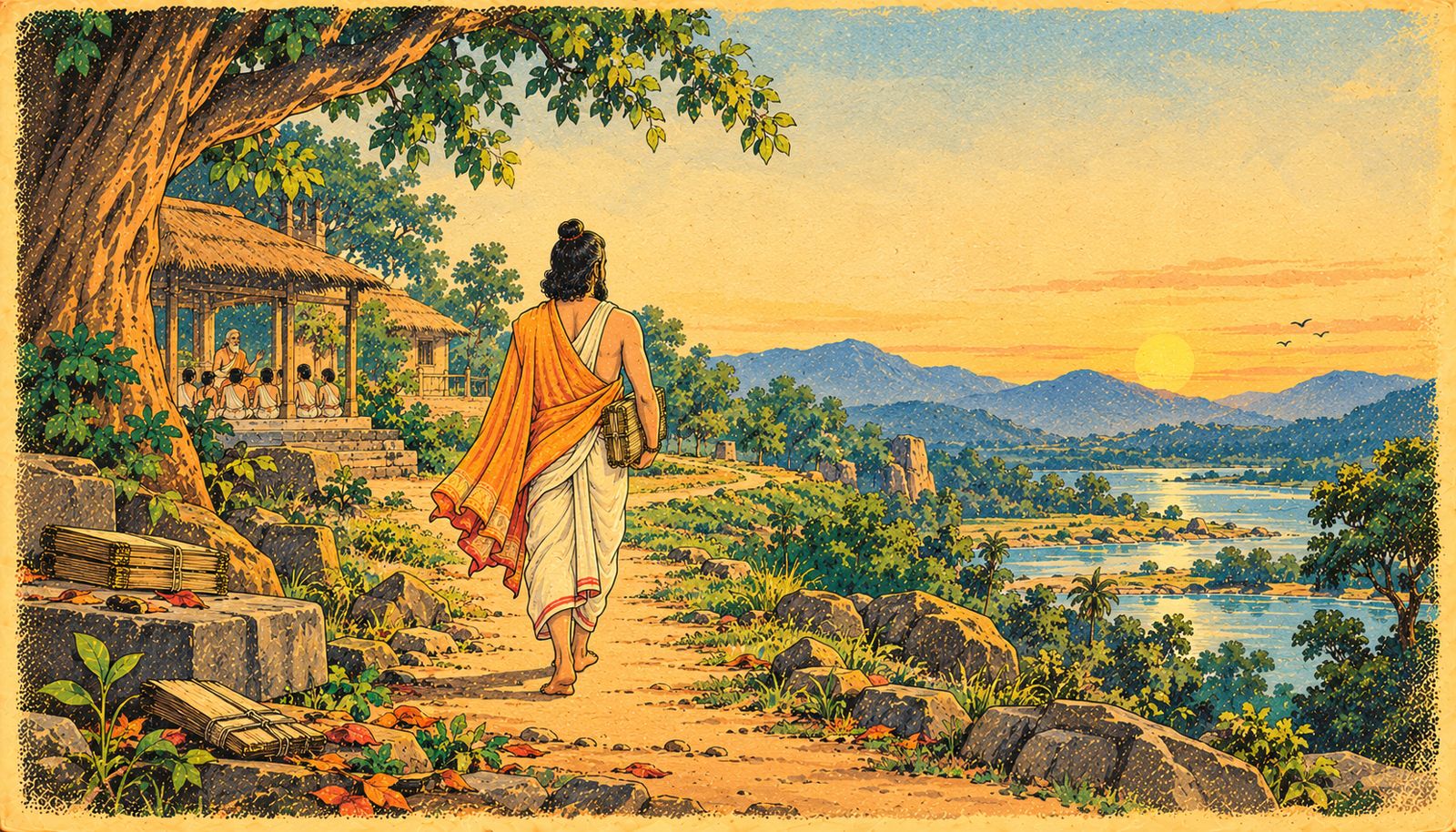
The maverick leaves his father’s ashram.
These acts, and others like them in which he took extreme positions, got him expelled from Uddalaka’s ashram. He was a maverick, bent on changing everything he did not like. But as they say, “Shaadi karaa do, sab theek ho jayega”: get him married and all will be well. Shvetaketu reunited with his childhood friend Suvarchala and married her.
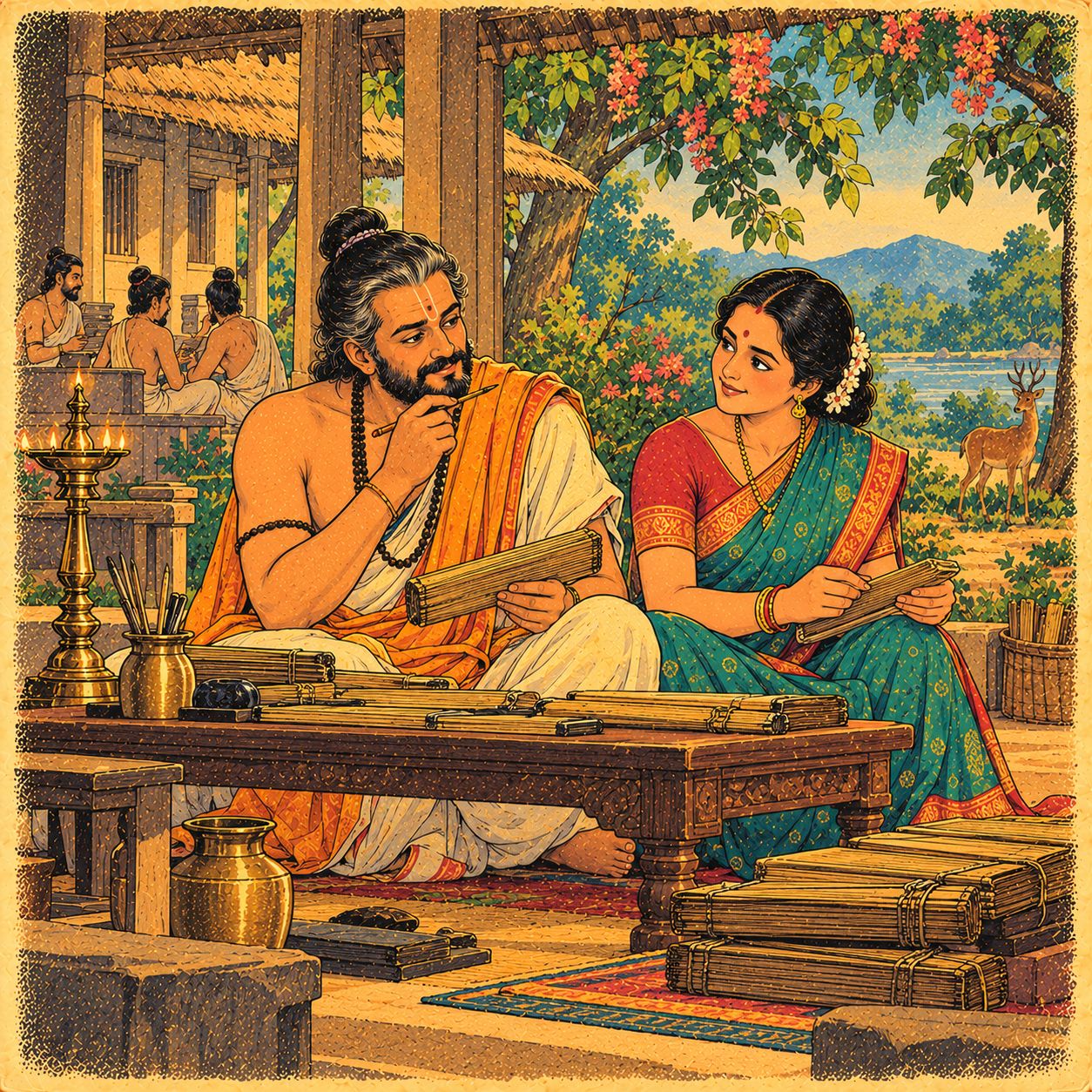
Shvetaketu and Suvarchala. The maverick, mellowed.
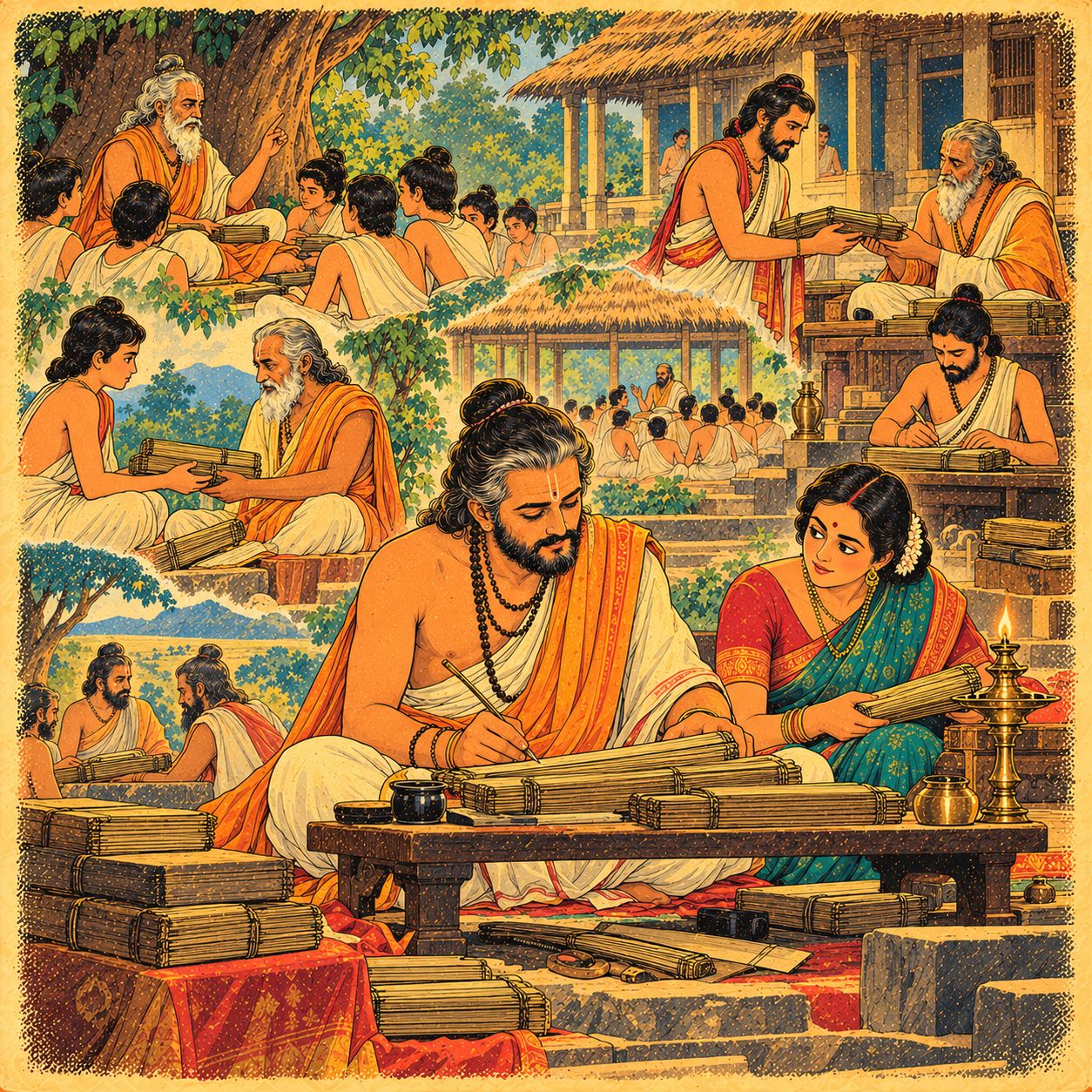
Marriage transformed him from a maverick into a mellow householder. He became a great Acharya, respected for his knowledge and wisdom. Shvetaketu laid down protocols for various yagnas and even allowed priests to eat sweets, which had earlier been forbidden. Later in life he worked on a very famous book, one almost synonymous with India’s identity in the rest of the world. No one anywhere has challenged India’s ownership of it, and as a work of research it has no parallel. The book’s journey begins with the seer Nandi, who wrote it first. Shvetaketu painstakingly condensed it into a book of just five hundred chapters, called the Kamashastra. After successive revisions by Babhravya, Suvarnanabha, Gonardiya and other scholars, Vatsyayana composed the Kamasutra, with additions from the ‘Vaishika’ and ‘Samprayogika’. The rebel who questioned everything, who detested polygamy and drinking, composed the Kamashastra in his later life and even allowed his disciples to drink. He shows that learning is change, that clinging to beliefs is stagnation, and that letting go is growth.
Five hundred chapters, condensed by hand.
Seven pheras
What I wish to leave you with is this: the changes Shvetaketu ushered in. Before him, society was functioning well by the morality of its day. He came along and changed what he saw as wrong. Much of what we live with today comes from him; the ideals of ek-patnivrata and pativrata are just one part of it. This is where the Upanishads become complex. It is a simple story, yet it has shaped the lives of millions upon millions across millennia. At its root, it is a simple shift from one system to another, made without judgement.
Read the story of Shvetaketu and his tryst with destiny, and you may see that change is the only constant in the growth of the Self.