Thumbs in the Belt Loops
the poseEver since I left school, I have never seen (and probably you haven't either) a teacher of a knotty subject like mathematics spend more than half of every lecture with both thumbs hooked firmly into the belt loops of his jeans.
He was the cool dude of the school, for him it was probably a stroll in his college, and every now and then popping into a class, and just standing there smiling, silently, like a yogi who has attained nirvana, nothing bothered him, not the loud noise of the class, nothing ..it was nirvana
like a yogi who has attained nirvanaThe method, in one line
The Lucky Draw
how he got MathsOriginally he was a Geography teacher, and probably that is his mojo too, but somehow in some high spirit of inspiration, someone came up with the idea that he should be a Maths teacher. I guess it was one of those days,,, there was blank in front of Maths Teachers Name,, so someone just did a lucky draw, and wallah.. Saeed Mujawar would be the Maths teacher.
Now, he was good at Geography. Probably great.

The Merit Board
an anecdoteAn anecdote here.
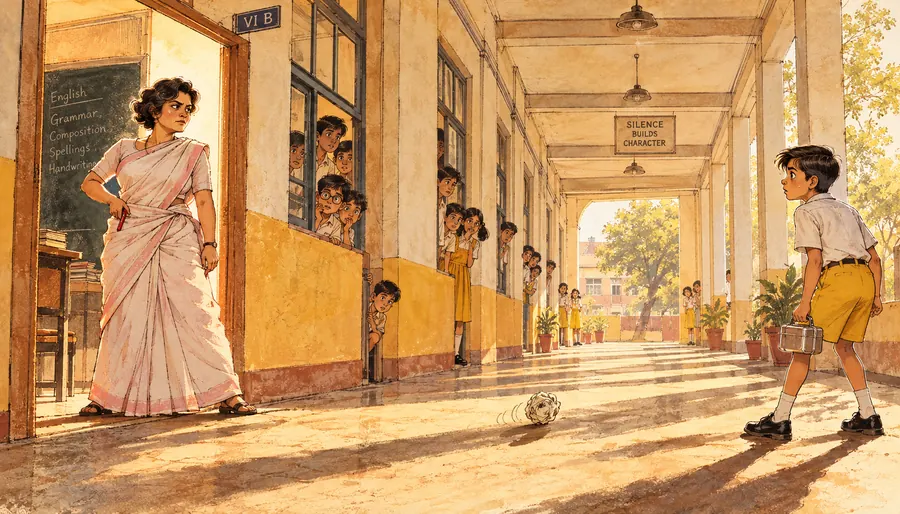
When you enter the main square of Crescent, right above the principal's cabin, there is a brown wooden board. It carries the martyr list: the students who scored the highest in the tenth-standard board exams.
For years and years, the board that was meant to inspire was the biggest source of depression. It had many names in white and a single name in yellow. Yellow, the school colour, was reserved for the ONE who had secured a rank in the board exams.
How can fourteen white names and a single yellow name INSPIRE!!

The Stencil
his greatest weaponAnyway, the cool dude single-handedly changed the narrative.
His greatest weapon, with which he empowered his students, was the stencil of India's map. His foot soldiers went out armed with this shastra and became legends, as year after year, students got 40 out of 40 in Geography.
He showed them that you can excel in your own field rather than being depressed about things.

I never quite understood the stencil part. The same stencil was sold outside almost every school in Pune. What made it special in the hands of a Crescentian is not quite known. All I know is this.
When in Doubt, Draw India
exam strategyIf there was a question in Geography to which you had no clue whatsoever, you could fill the page by drawing the map of India.
And if the question was about rivers, draw a bunch of lines starting in the north and running east, another bunch starting in the middle and running east, and two, yes TWO, lines running from east to west.
Q. Rivers of India (answer)
40/40| Rivers | Direction | Lines |
|---|---|---|
| Himalayan | North, then east | a bunch |
| Peninsular | Middle, then east | another bunch |
| The rebels | East to west | TWO (yes, two) |
The point was that a Crescentian could feel confident that, if nothing else, they would do well in Geography. (Which rhymes with Mohammed Rafi.)
Memory Pins
points, not answersBesides the jeans, he brought some style to the teaching too. He gave out memory pins you could not forget, like TWO east to west. Or: if you forget everything else, the major minerals are in Bihar. Or: Chhota Nagpur is to the east of Bada Nagpur.
Memory pins
- TWO rivers flow east to west.Rivers
- Forget everything else: major minerals are in Bihar.Minerals
- Chhota Nagpur is east of Bada Nagpur.Plateaus
- High → low. Winter: high north, low south. Rain. Returning monsoon.Climate
- One chapter = one lecture.Time management
The best thing was that a whole chapter could be wrapped up in a single lecture. There was a flow, a logic. And while other teachers dictated long answers, he gave out just points. Like:
Wind moves from high pressure to low. In winter, high pressure in the north, low in the south. Wind flows, brings rain. Called the returning monsoon.
That's it. That was the chapter.

The Nirvana Method
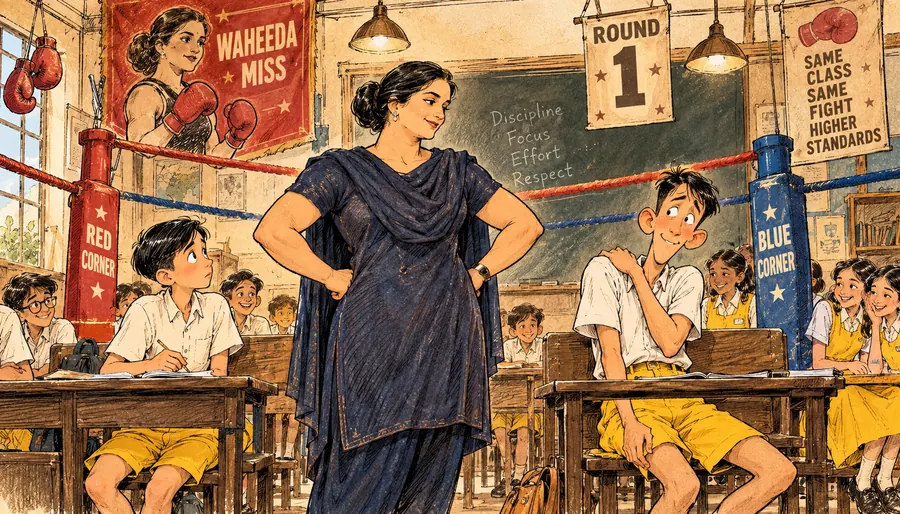
smile, joke, repeatHe was a jolly teacher. He taught with a smile, a very wide smile, cracked jokes and kept the classroom buoyant. Extremely lenient.
I actually do not remember him giving any homework. Maybe in ninth... no. Definitely not.
Maybe in ninth... no. Definitely not.On homework
Return Load
Dubai, and backHe had a brief escapade to Dubai and, thankfully, he returned. And probably as return load, Maths was added to his geographical skills.

Maths-wise, he was against solving too many problems. He approached Maths with his geographical logic: know the concept, and then remember that the concept repeats itself over and over again. There is a temperate zone, an arid zone, a polar zone; and by logic, if something is in the north, it has to be in the south too.
His Maths ran on the same lines. There are linear, simultaneous and quadratic equations. Here is the formula for quadratic equations. It solves one problem. It solves another problem. So it must solve all similar problems. Oh yes, the concept repeats itself in numeric form or as a word problem, but if it can be solved as numbers, it has to be solvable as a word problem.

Maths Is Simple
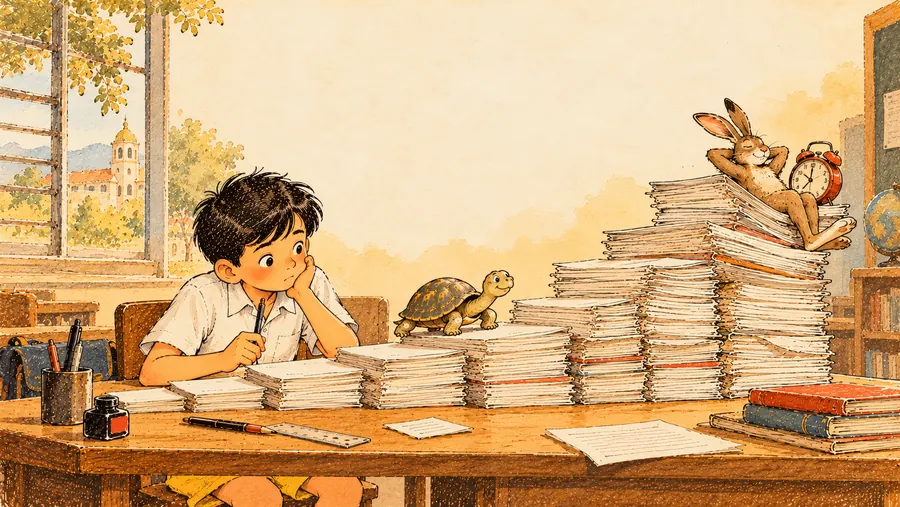
what I learntFor me, it was quite refreshing. For years and years it had been hammered into me that Maths is repetition, practice and hard work.
Under his style I learnt, if it is repetitive, what’s the point in practicing it again and again, and then if you are not doing it again and again, it is not hard work, and if it is not hard work, then it is probably not that hard. So folks out there, Maths is simple !!

— Vinaay Patil
The Nirvana Method
A proof, as taught
- It's repetitive
- Why practise it?
- Not practising
- Not hard work
- Not that hard
- Maths is simple !!
Days Under the Crescent Sun
Stories from school days and a 1990s Pune childhood: plans that were too clever, teachers who were never questioned, and the people who made it all bearable.
More from the series →