Why twelve signs and not eleven? Where the Nakshatras, the chart and the days of the week come from.
AuthorDagadu D
SeriesI of IV
Reading8 min
An introduction to the terms used in Jyotish, not a course in it.
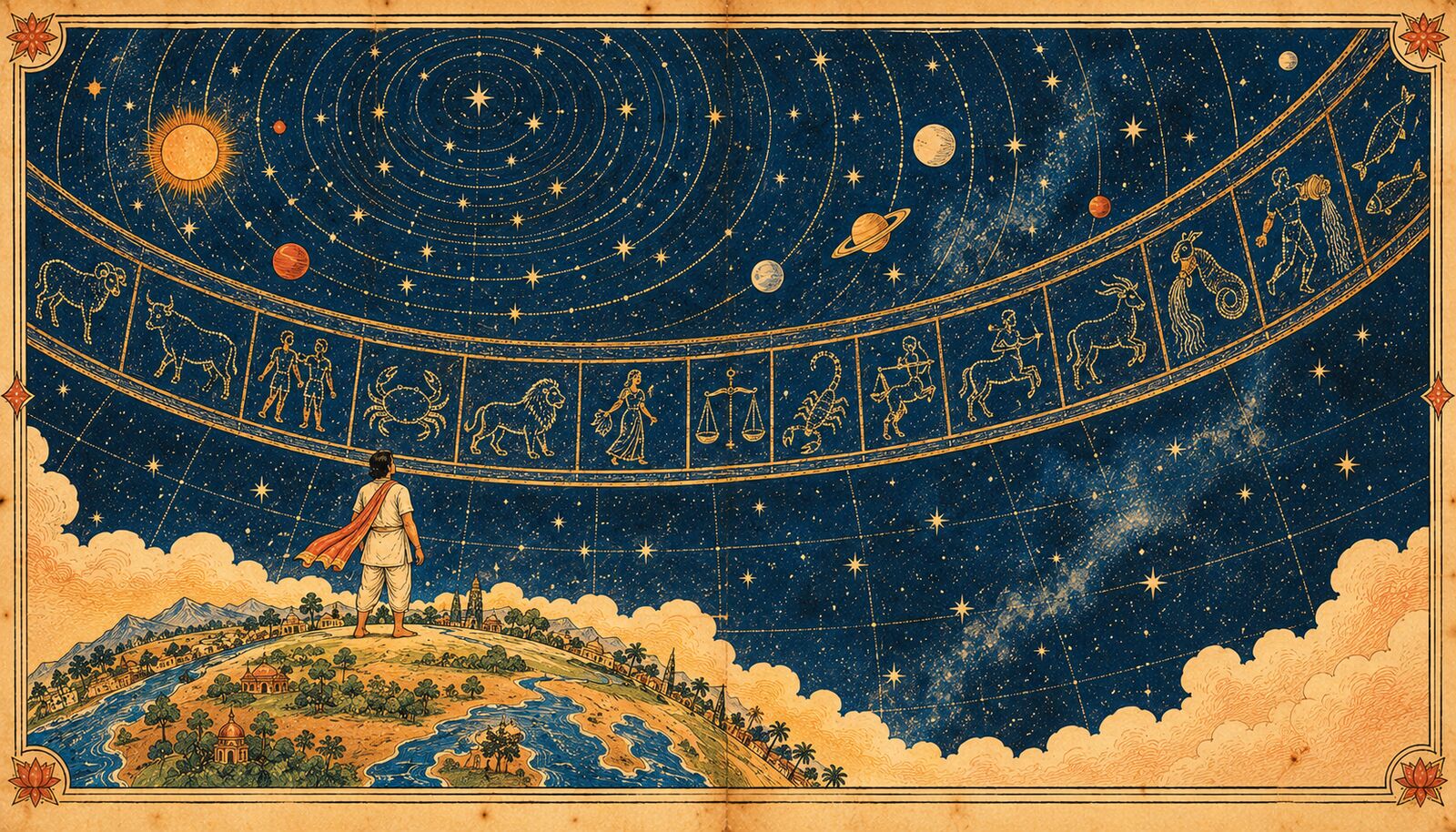
Stand on the Earth and look out: the sky turns around you in a full circle of 360°.
At some point or other, most of us must have wondered why certain things in Jyotish are represented the way they are. Why are there 12 signs, for instance? Why not 14, or 11? I grappled with similar questions, and in doing so I was led into a different realm of Jyotish: a non-predictive one.
The first thing one notices on looking at a horoscope (a chart, a Patrika) is that it has 12 divisions. It may be drawn as a circle, a square or a diamond, yet every form carries the same 12 basic divisions. It is 360°: a circle divided into 12 parts of 30° each.
Imagine you are large enough to stand on the Earth and look out into space. You are looking into the celestial sphere. The inner surface of this sphere is covered with the stars we see at night. The stars move across the dark canvas of the sky, and their motion is circular: 360°. You can see the same effect in a time-lapse of the night sky.
Twelve Rashis
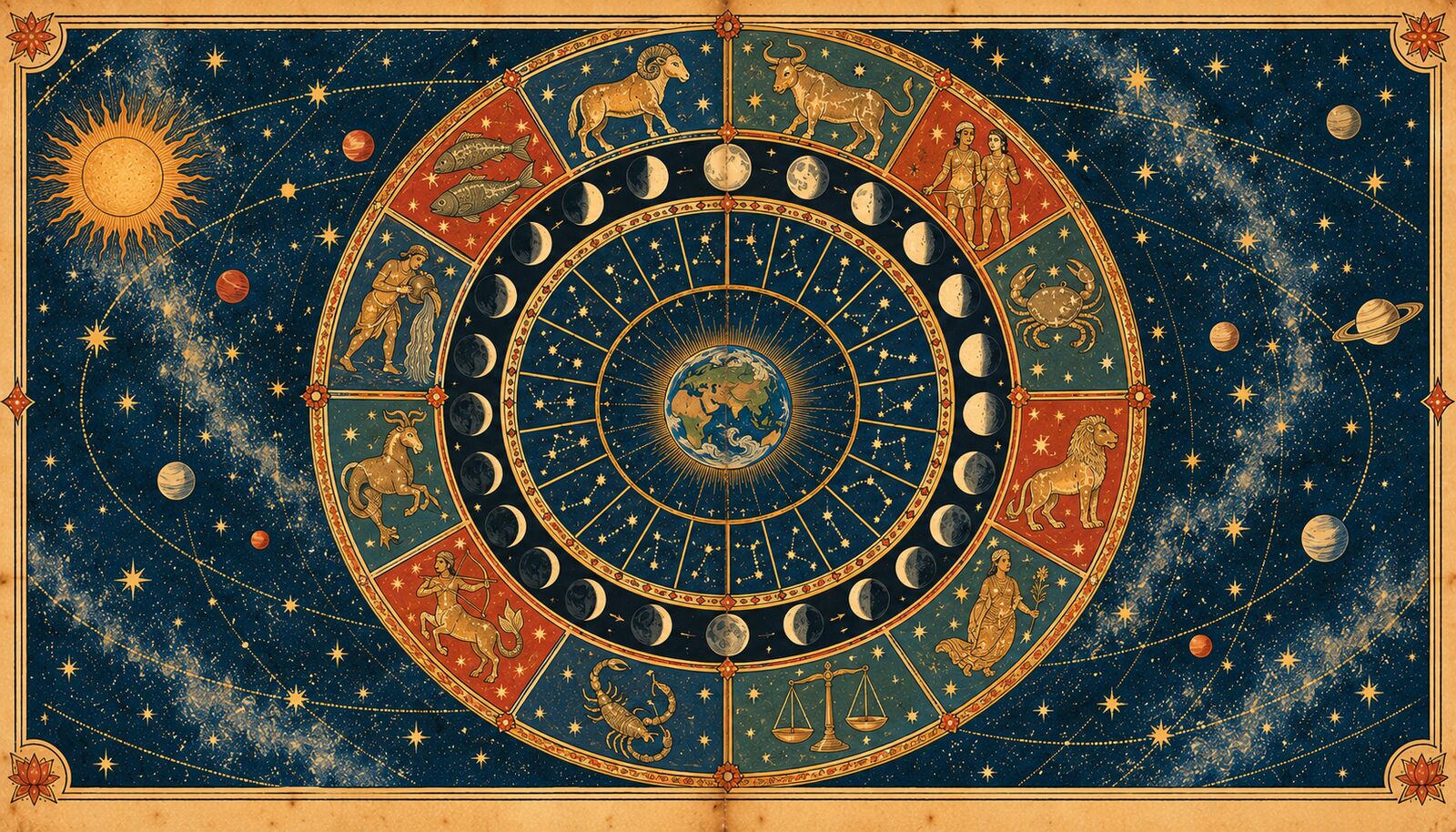
Now a bit of astronomy. The Moon takes around 27 days, 7 hours, 43 minutes and 11.5 seconds to complete one revolution around the Earth. However, from one full moon to the next takes approximately 29.5 days, because that depends on the relative motion of the Sun and the Moon. Round 29.5 days off to 30, multiply by 12, and we get 360 days, approximately a year. This ‘12’ is the basis of our primary divisions. In English these divisions are called the Zodiac; in India we call them Rashi.
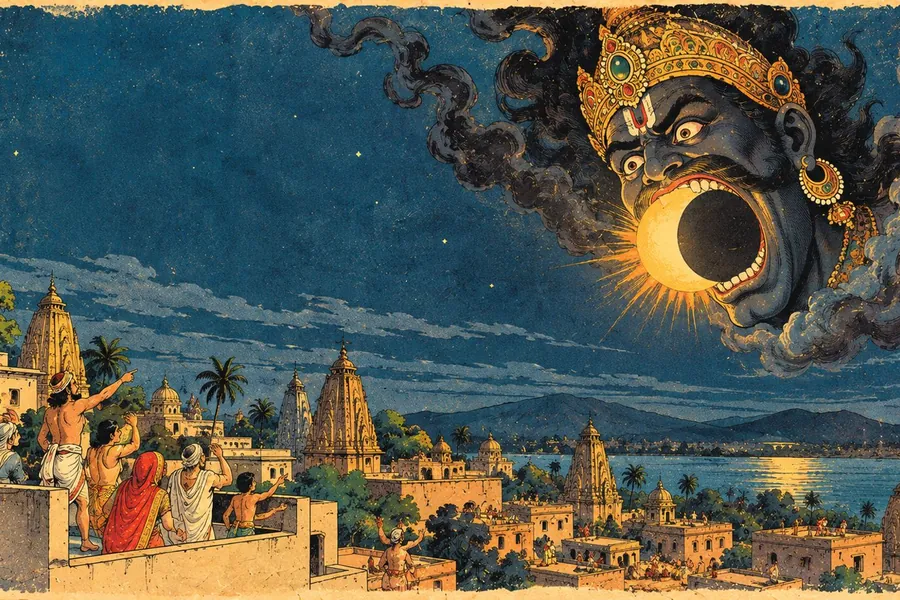
Like many Indian words, Rashi can carry many meanings. It may mean abundance, or the knowledge the Rishis gave us. One interesting folk reading links it to Rahu and Ketu. Ketu is also called Shikhi, the crested one: take ‘Ra’ from Rahu and ‘Shi’ from Shikhi, and you get Ra-Shi. It is a playful etymology rather than a grammatical one, but this Rahu-Ketu reading may help in understanding the Kaal Sarp Yog.
Twenty-seven Nakshatras
Besides the 12 signs, we have the Nakshatras. The Moon’s revolution around the Earth is our lunar month. Dividing 360° by the length of the lunar month (about 27 days) gives us 27 divisions of 13°20′ each. But the Moon actually takes a little over 27⅓ days, and one way to see it is that this extra third is honoured by a 28th Nakshatra, the famed Abhijit. It has no portion of its own; it is carved out of the zodiac at the junction of Uttarashadha and Shravan, roughly 4°13′ in all. So we get 28 Nakshatras, with 27 used in most calculations.
Twelve Rashis outside, twenty-seven Nakshatras within, and the Moon walking through them.
Each Nakshatra is further divided into four smaller steps called Nakshatra Pads. The division by four corresponds to the four pillars of Dharm, Arth, Kaam and Moksh (13°20′ ÷ 4 = 3°20′ for each Pad). These four pillars are the soul’s goals for the current lifetime. In a way, this subdivision is akin to reaching the level of the soul in Jyotish.
108 Pads
Now that the basics are covered, let us look at the chart itself. As mentioned earlier, a chart can be any shape: circular, square, diamond and so on. Western astrology mostly uses the circular form, while in India one of the following is used.
The North Indian chart, the diamond-shaped chart, is attributed to Guru Shukracharya. The South Indian chart is a square, laid out like a homa or yagnya kund, and is attributed to Guru Brihaspati. The Eastern style appears to draw on both.
Two Gurus, two ways of drawing the same sky.
No style is better than the other; it is just what you are used to. Whatever one practises with more is what one becomes accustomed to. Having said that, within Indian practice the diamond style carries the Rajasic element, while the South Indian havan style carries the Sattvic element. The charts are also read slightly differently: the Northern and Eastern charts are read anticlockwise, while the South Indian chart is read clockwise.
In the North Indian chart, the first house is also called the As (Ascendant). Each house covers 30 degrees. The important thing to remember is that house numbers are not written in the chart. So if you see a chart like the one below, the numbers correspond to sign numbers.
A North Indian chart. The numbers are signs, not houses: 10 in the first house (top centre) is Makar, Capricorn. Read anticlockwise: house 2 holds sign 11, house 3 holds 12, and so on.
In this chart, the number 10 in house 1 refers to the 10th sign, Makar (Capricorn).
In the South Indian chart the signs stay fixed and the houses move, so the same chart in the South Indian style looks like this:
The same chart in South Indian style. The signs never move; only the Ascendant (As) is marked, here in Makar, and the houses are counted clockwise from it.
The Ascendant occupies the position of Capricorn in this chart.
The Ascendant, called the Lagn, is nothing but the sign rising in the east at the moment the native is born. The planets are placed with reference to it, according to their positions in the sky, like a screenshot of the sky at the moment of birth. In this context, Rahu and Ketu are mathematical points 180 degrees apart. They have no physical presence, yet they greatly affect how we perceive the celestial bodies (more on this later).
Seven lords
There are hundreds of other terms, and one cannot explain them all in a short article. Take Hora, which comes from Aho-Ratra (day and night) and denotes the hours. This concept plays an important role in how the days of the week are derived. To see this, simply arrange the planets in ascending order of their speed around the Sun:
Saturn
Jupiter
Mars
Sun
Venus
Mercury
Moon
SlowestFastest
The seven Grahas in order of their speed as seen from the Earth.
(Rahu and Ketu don’t get this honour, and the outer planets are not considered.)
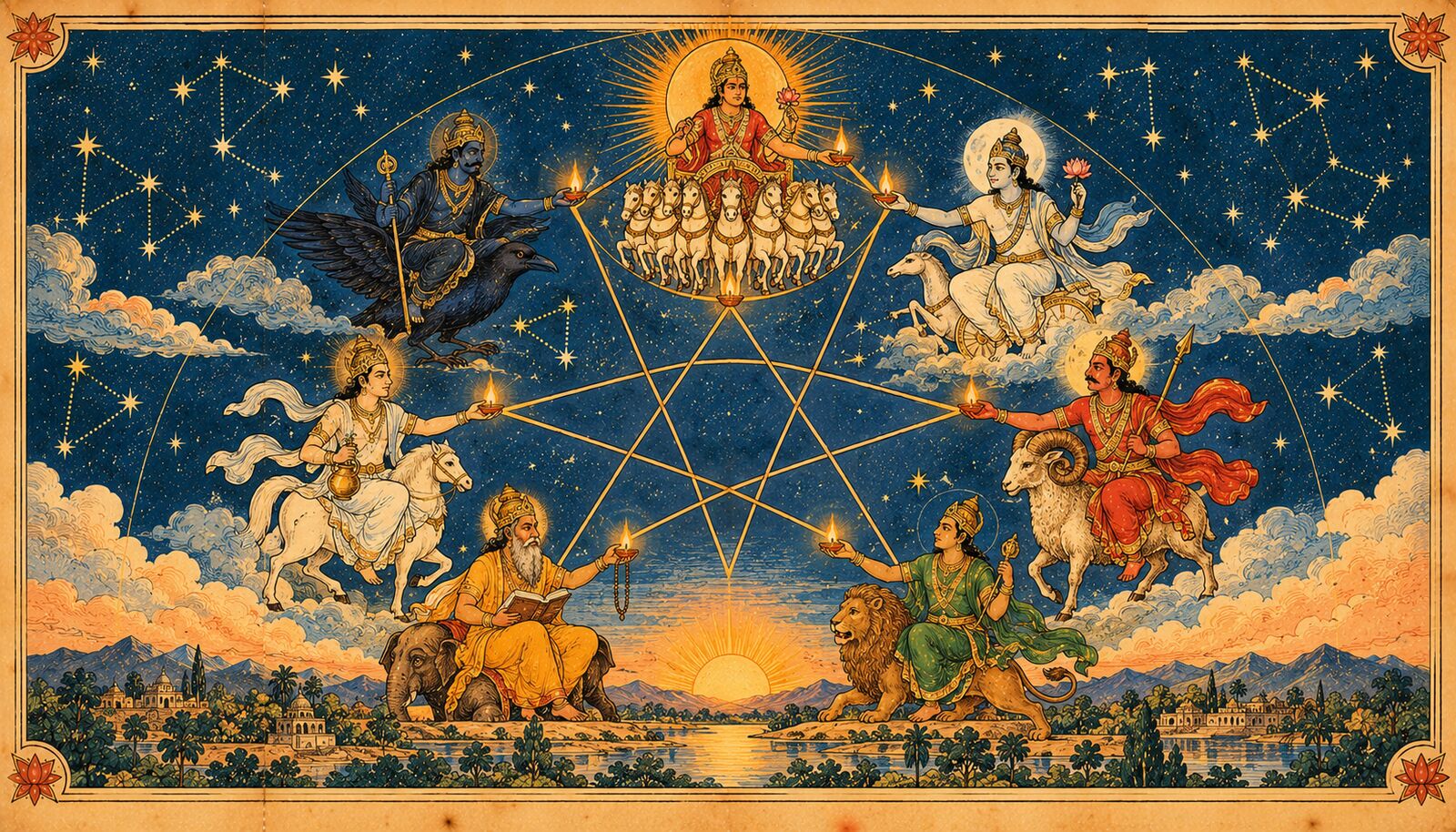
The 24 hours of a day are assigned to the planets, one per hour. We always begin with the king, the Sun. So the first day is Sunday, and the first hour of the first day belongs to the Sun. Then we follow the cycle: the Sun, then Venus, then Mercury, then the Moon, then Saturn, then Jupiter, then Mars, and back to the Sun, round and round. The cycle carries over into the next day. For example, the first day ends on Mercury, so the first hour of the next day begins with the Moon. The days follow a cycle too, from Sunday to Saturday and back to Sunday. In the Indian concept this cycle has neither a beginning nor an end, which is why Indians have no concept of a weekend. The week can begin on any day: some calendars begin with the king, Sunday; others, in honour of the Guru, begin with Guruvar (Thursday).
Seven Grahas pass the hours from hand to hand, and the days fall out of the pattern.
This is in contrast to the Abrahamic religions, in which God made the Earth and life in six days and rested on the seventh, which gives us the concept of a weekend, a day of rest.
Hora
Sun
Mon
Tue
Wed
Thu
Fri
Sat
1
Sun
Moo
Mar
Mer
Jup
Ven
Sat
2
Ven
Sat
Sun
Moo
Mar
Mer
Jup
3
Mer
Jup
Ven
Sat
Sun
Moo
Mar
4
Moo
Mar
Mer
Jup
Ven
Sat
Sun
5
Sat
Sun
Moo
Mar
Mer
Jup
Ven
6
Jup
Ven
Sat
Sun
Moo
Mar
Mer
7
Mar
Mer
Jup
Ven
Sat
Sun
Moo
8
Sun
Moo
Mar
Mer
Jup
Ven
Sat
9
Ven
Sat
Sun
Moo
Mar
Mer
Jup
10
Mer
Jup
Ven
Sat
Sun
Moo
Mar
11
Moo
Mar
Mer
Jup
Ven
Sat
Sun
12
Sat
Sun
Moo
Mar
Mer
Jup
Ven
13
Jup
Ven
Sat
Sun
Moo
Mar
Mer
14
Mar
Mer
Jup
Ven
Sat
Sun
Moo
15
Sun
Moo
Mar
Mer
Jup
Ven
Sat
16
Ven
Sat
Sun
Moo
Mar
Mer
Jup
17
Mer
Jup
Ven
Sat
Sun
Moo
Mar
18
Moo
Mar
Mer
Jup
Ven
Sat
Sun
19
Sat
Sun
Moo
Mar
Mer
Jup
Ven
20
Jup
Ven
Sat
Sun
Moo
Mar
Mer
21
Mar
Mer
Jup
Ven
Sat
Sun
Moo
22
Sun
Moo
Mar
Mer
Jup
Ven
Sat
23
Ven
Sat
Sun
Moo
Mar
Mer
Jup
24
Mer
Jup
Ven
Sat
Sun
Moo
Mar
SunVenusMercuryMoonSaturnJupiterMars
The 24 horas of each day, counted from sunrise. The lord of the first hora names the day; follow any column to its foot and the cycle carries on into the next day.
Remember that our perspective in all this is geocentric: the Earth is the centre. That is also why the Sun, despite not being a planet, is part of the structure. You can think of it as essentially taking the Earth’s place in the scheme of things.
An important thing to note here: nothing is written in stone, and a person has total freedom to practise as he wills. Just as in the Vedas, both Astiks and Nastiks find a place.
Three parts of 120°
The concept of a trinity, common to many religions of the world, is found in Jyotish too, because Jyotish is in essence a Vedang, a limb of the Veda. The trinity is the mind, the body and the soul, or Brahma, Vishnu and Mahesh. In the Manusmriti, Manu defines the length of a day for the gods in relative terms: one day of the gods is one human year. The Sun moves about one degree through the Zodiac each day. Applying the same relative notion, this one degree of motion represents one human year. Take the circle and divide it into three parts: mind, body and soul. Each part is 120 degrees, corresponding to 120 human years. At each 120-degree point one part ends and the next begins. In Jyotish this lays the foundation for the belief that the human lifespan is 120 years. The end of each of these cycles is called Gandanta. We will see later that each 120-degree point has its own significance in Jyotish.
I have tried to cover a few basics of Jyotish that I may use in the articles to come. I have mentioned certain terms and their meanings without going too deep, only to avoid preaching or trying to teach Jyotish.
The aim was simple: to show how philosophy and astronomy are glued together in the language of mathematics.