You would have heard the term Rahu Kaal (Rahu Kalam) often enough, if not from a god-fearing grandmother trying to scare you, then at least in some movie. Rahu Kaal, the part of the day that Rahu rules, strikes fear in many. It is the time of day under the control of Rahu, the dreadful. In an earlier avatar, his name was Swarbhanu.
Rahu
The Descent into Chaos
Swarbhanu, the stolen Amrut, and a head that can never be full.

SunMonTueWedThuFriSat
Swarbhanu doesn’t sound quite so dreadful, but he was the same being. In the Vedas, one can watch the gods grow. A god who has two or three qualities in the Rigved gains two or three more in the later Vedas, and these are treated as newly revealed truths about the same god. Even in his earliest days, Swarbhanu was after the Sun, and even then he eclipsed him.
Swarbhanu approaches
All this was before the Samudra Manthan, one of the most important events in the Puranas. The churning of the ocean has parallels in many other ancient stories around the world, especially in Norse mythology. This is how the need for it arose.
Once, Indra inadvertently insulted Rishi Durvasa. The Rishi had gifted him a garland, which Indra handed to his elephant, Airavat. Troubled by the bees on it, Airavat threw the garland to the ground. The sight of his gift in the dust enraged the short-tempered Rishi, and he cursed Indra to lose all that he had.
Cut to: a war between the Asuras and the Devas, in which the Devas are battered and lose everything they have.
Cut to: Vishnu’s court. The Devas, led by Indra, arrive to plead for his help. Vishnu advises them to handle it diplomatically. They settle on the Samudra Manthan as a way to regain their lost wealth. But a feat of such astronomical scale needs the help of the Asuras.
Cut to: the vast shore of the Kshirsagar, the ocean of milk. The two eternal enemies work out the details. Mount Mandar is placed on the back of Kurma, the tortoise, and Vasuki, the serpent king, is wound around it as the churning rope. The ocean is churned until the pot of Amrut rises from it, ready to be shared.

Cut to: Devas and Asuras sitting in two straight lines, like nursery children, being served Amrut by none other than Mohini. She begins with the Devas, planning to finish the Amrut before it ever reaches the Asuras. Clever Swarbhanu, aware of the Devas’ sleight of hand, disguises himself as a Deva, gatecrashes their line and sits between the Sun and the Moon. Just as Mohini pours the Amrut for him, the Sun and the Moon expose him as an Asura. Instantly, Vishnu’s Sudarshan Chakra slices through Swarbhanu’s throat. But he has already swallowed the Amrut and become immortal.
The head became Rahu.The body became Ketu.
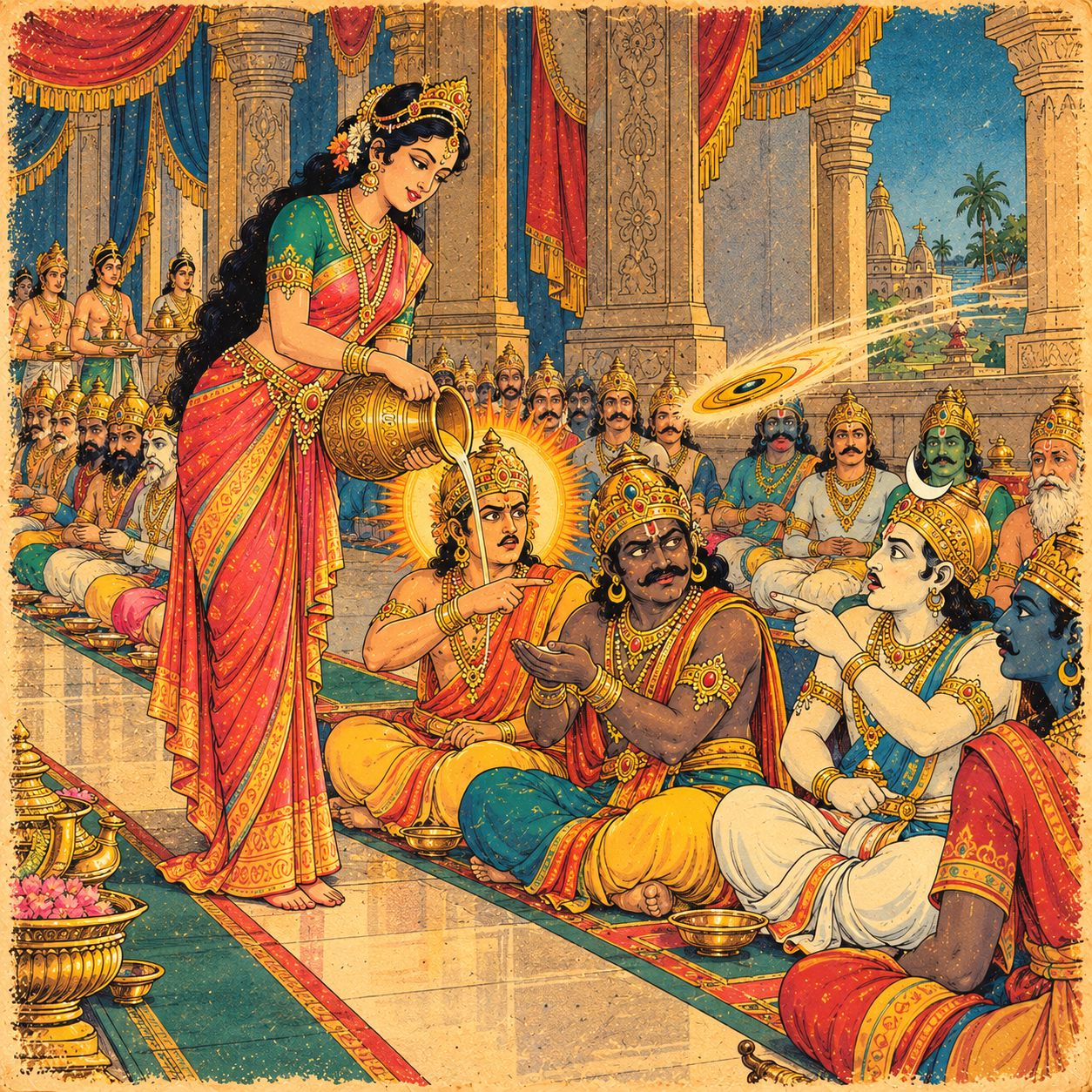
That’s his story. There are a few variations, but the crux is this: during the Manthan, the Asuras and Devas worked together to win the jewels of the universe. The Devas tried to keep the Amrut for themselves. Swarbhanu saw through it and outwitted them. He succeeded, but with a catch.
That was the linear part of Indian storytelling. The ideas beneath much of the story depend on the reader’s capacity to ponder.
First contact
A few seers and sages have pondered on our behalf and shared the many layers such stories hold. These stories form the basis of Jyotish. Through them we learn what a particular planet means, what it intends and what it is capable of. Rahu and Ketu are among the hardest planets to judge, understand and interpret.
Of the two halves, I will limit myself to Rahu. As we all know, Rahu is the dreadful one. He is, after all, an Asura, so by definition we should dread him. He has always fought the Sun, the hearth of our solar system, and eclipsed him.
Rahu holds sway over Kaliyug. The greed associated with Kaliyug is built into Rahu: by not waiting his turn for the Amrut, he showed his greed. Maya, another word tied to Kaliyug, also belongs to Rahu. He wrapped himself in Maya, disguised as a Deva, to sit among them and drink the Amrut. Rahu therefore represents the faculty to transform, to take on another’s form, to create illusion. People who live by this ability are spies, actors, thieves and politicians. Rahu is the king of diplomacy, so every diplomat falls under his realm.
Half the Sun
Rahu saw the deceit the Devas had planned and acted on it. He could see that Mohini was none other than Vishnu himself, proving that he can see through Maya. This ability to see through illusion is a gift, and it makes him a planet uniquely suited to Kaliyug: along with the skill to create an illusion, he holds the power to break through one. And Rahu did not share what he knew with the other Asuras. That makes him self-centred, quick-thinking and independent.
The more closely one reads that story, the more one learns about Rahu and his importance in this era. Other stories in the Puranas shed light on him too. Remember, he swallows the Sun without ever touching it. That, again, is Maya, but his Maya casts long shadows on us earthlings. Rahu is hyper-intelligent, extremely good at setting goals and hyper-motivated to reach them. But he is just a head without a body; his thirst has no bottom. Nothing satiates him. Once he sets a goal he starts to consume, and there is no end to it. Nothing can set one free from his grip.
As good as Rahu sounds, he is terrible for exactly the same reasons. Rahu is the ill of excess. He can set extraordinary goals and keep you motivated like nothing else, but it is all a mindless rush, and worst of all, he cannot guarantee the goal. That is the illusion he creates. It may fool the people around you, but when the time comes, his Maya breaks. He himself never got what he wanted, despite all his effort.
“Haath aaya, muh na laga.”It reached the hand, but never the lips
Rahu is the classic case. He will surely take you to the highest position, close to your goal, and then deprive you of it, so completely that it remains a lifelong scar.
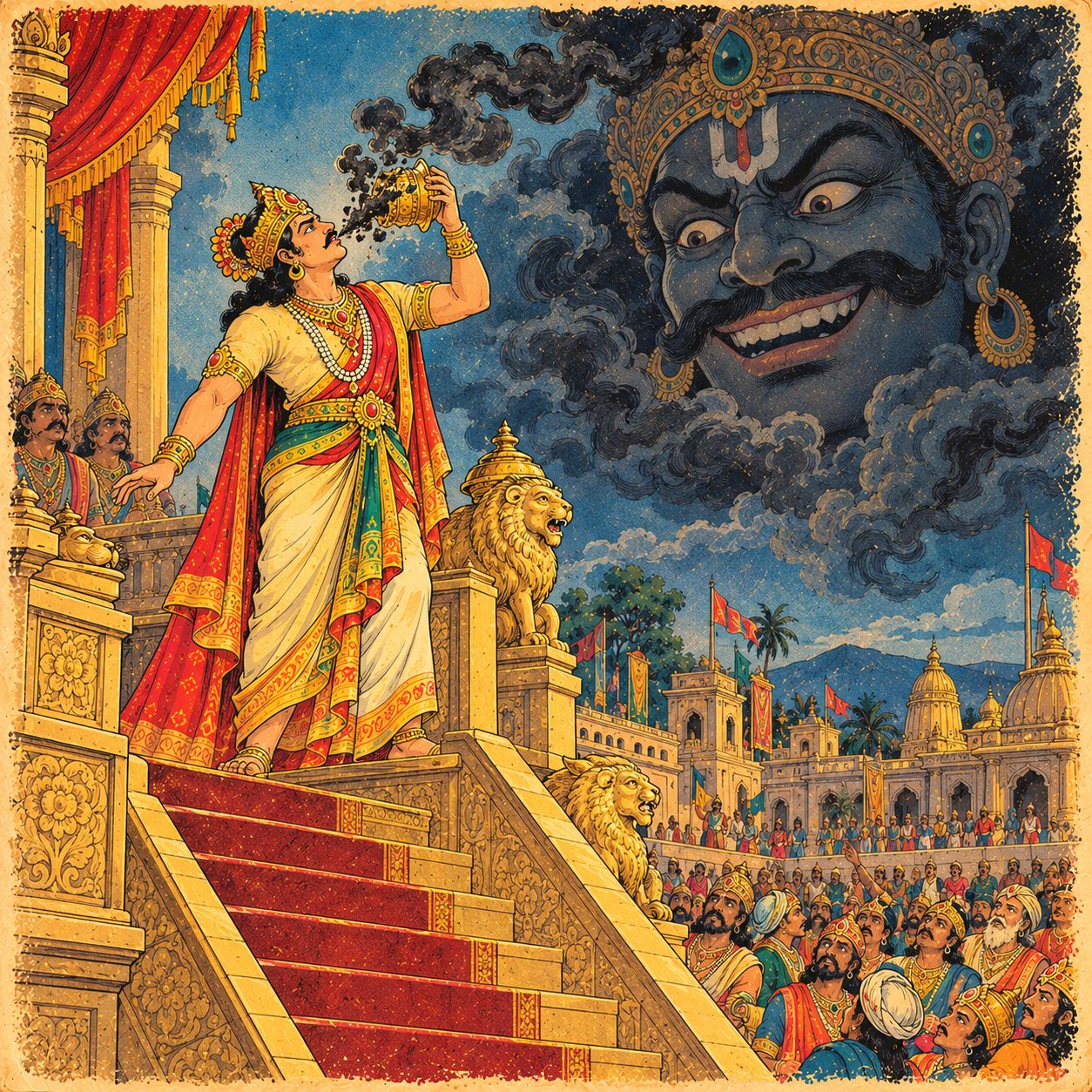
Almost gone
You will notice many people who reach a high position amid gala and fame, and then fall from the top into the depths of anonymity and the nadir of disgrace. The prime example would be Trump: Jupiter gave him the high position, but Rahu dumped him hard. Rahu is an excruciatingly harsh teacher. He etches his lessons on the soul, and the soul carries them from one life to the next. Remember, Rahu is the reason (or at least the sign of the reason) we are born.
Rahu can undoubtedly give you fame. He can make you a Trump, a great guru like Bhaktivedanta Swami Prabhupada, a great actor, or a famous spy like Mata Hari. But Rahu’s energies are the hardest of all to handle, which is why his path so often turns out badly. The intelligent fundamentalists, who know exactly how to twist and manipulate to cause maximum damage, belong here. India has many godmen behind bars, the best examples of Rahu gone awry on the path of spirituality. The evil genius of Rahu is his duality. He can make you deeply spiritual and, at the same time, riddle you with materialism and the clichéd greed for tan, man, dhan.
Rahu can take one on a rollercoaster of a life; extremes are the key word. He is like Lenka’s song ‘Everything at Once’: his desires know no bounds, and he wants to be everything the mind can imagine. This power of imagination lets Rahu expand things to the vastness of the universe or shrink them to the size of an atom. Remember, he gambled his life for immortality. He won it, and lost half of himself in the bargain. That is what he is: the highest position or the lowest. There is nothing in between where he can work.
There is much more to say about Rahu, and even all of it would only scratch the surface. There is a lot to learn from his story, but I leave that to the reader’s wisdom.
Just remember: he is a black hole, with no bottom.
Read next
← All Mythos Jyotish · Part IBasics of AstrologyWhy twelve signs and not eleven? Where the Nakshatras, the chart and the days of the week come from.In common: Navagraha · Rahu · Ketu8 min read
 MythsDashagrivaRavan, the nine Grahas, and the one who stepped outside the circle.In common: Navagraha5 min read
 Jyotish · Part IIUnderstanding Accountability in AstrologyThe scientist gets a long rope; the Jyotishi gets a short one. Why we measure them with two different yardsticks.In common: Samudra Manthan7 min read