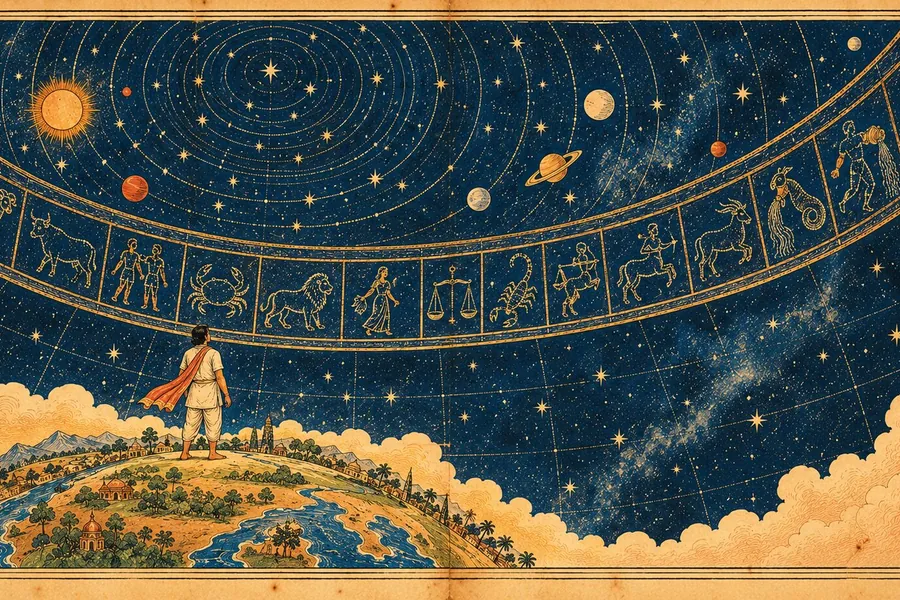
Mangal means auspicious. So why does Mangal Dosh frighten so many families at marriage time?
AuthorDagadu D
SeriesIII of IV
Reading8 min
New to terms like these? Start with Basics of Astrology, the first in the Jyotish series.
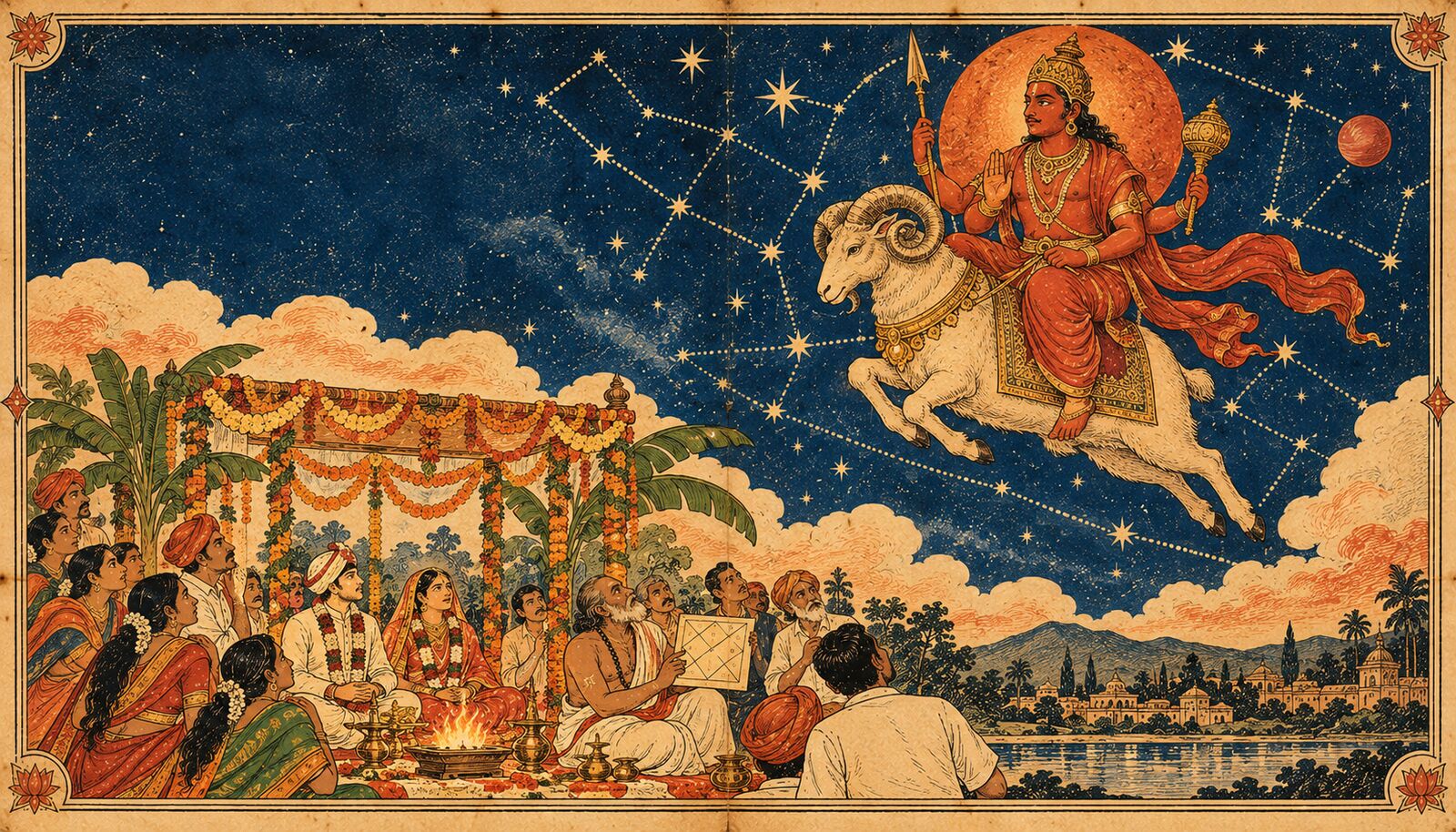
Mangal rides his ram over the mandap, and the families below look up in worry.
I am assuming most of you have heard this term at least once. I am also fairly certain that a vast majority of you are confused about its exact meaning. This (in)famous Yog comes up a lot in marriage consultations, and it gets blamed as the marriage-breaker in almost 95% of cases. But has anyone ever wondered why Mangal Dosh should break a marriage? Mangal is a positive word; it doesn’t have that ominous ring to it. Right?
In Jyotish, Mangal refers to the planet Mars, and the word also means auspicious. Dosh is usually understood as a defect, a problem, an issue or an evil. In reality, Dosh carries nothing of evil. Dosh simply means imbalance. So ‘Mangal Dosh’ literally means ‘Auspicious Imbalance’, and nothing else. All the fear-mongering built around it was meant to play on the innocent and profit from them. Over time this has spun out of control, despite sincere efforts by some well-meaning people. Earlier it was the Jyotishi who misused it; now even the common junta does.
An auspicious imbalance
Let us get a little deeper into this Auspicious Imbalance. (Warning: things might get a bit technical.)
In a Kundali (also called a Patri, or a chart), these are the basic elements:
There are 12 houses (Bhav).
Each house contains one zodiac sign, making 12 signs in all.
Nine planets occupy these 12 signs. (Vedic Jyotish does not include Uranus, Neptune or Pluto.)
Each house, or Bhav, represents certain aspects of life: 1st, self; 2nd, family; 3rd, effort; 4th, home and mother; 5th, education and children; 6th, health and enemies; 7th, partner; 8th, the occult; 9th, father and religion; 10th, profession; 11th, gains; 12th, loss and the pleasures of the bed.
More will be shared as we go along. (For now I am setting aside the why and how of the 12 signs.)
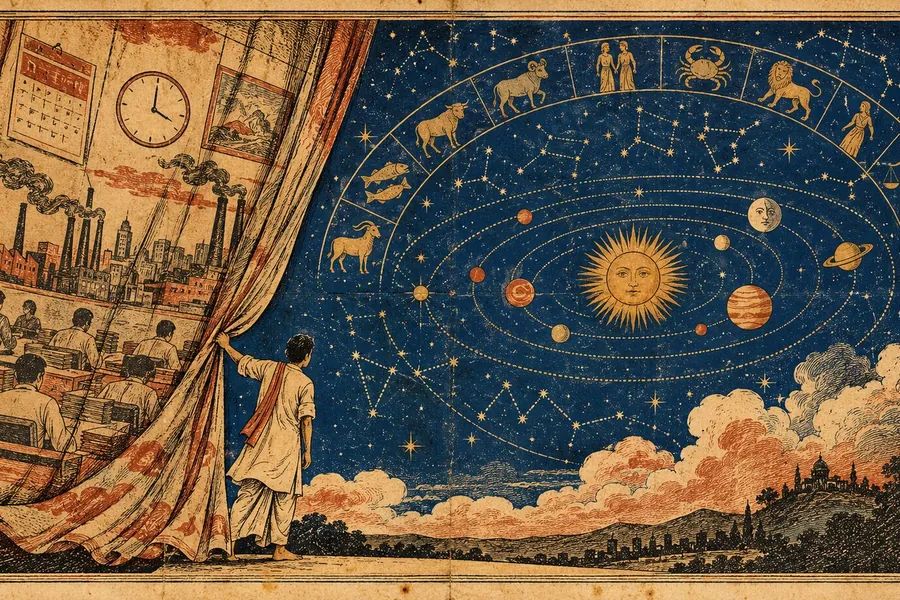
In simple terms, a chart is a snapshot, a screen grab, of the sky at the moment a child is born. Depending on that moment, the planets are cast into the signs according to their positions. This leads to the formation of various Yogs. It may happen that one or more planets sit in the same sign, just as they do in the sky: as above, so below. One such Yog is Mangal Dosh.
Definition
If Mars (Mangal) occupies the 1st, 4th, 7th, 8th or 12th house, it qualifies as Mangal Dosh. (A milder version of this Dosh also occurs when Mars is in the 2nd or 5th; more on this later.)
Mangal Dosh: 1, 4, 7, 8, 12Milder: 2, 5
The twelve houses of a North Indian chart, numbered anticlockwise from the top, with the sphere of life each one rules.
In the prevalent system of (mis)understanding, this is believed to cause havoc in the corresponding spheres of life: the 1st, self; the 4th, home; the 7th, marital discord; the 8th, death; the 12th, troubles in bed. This is a very simplistic and very cheap reading of the rule.
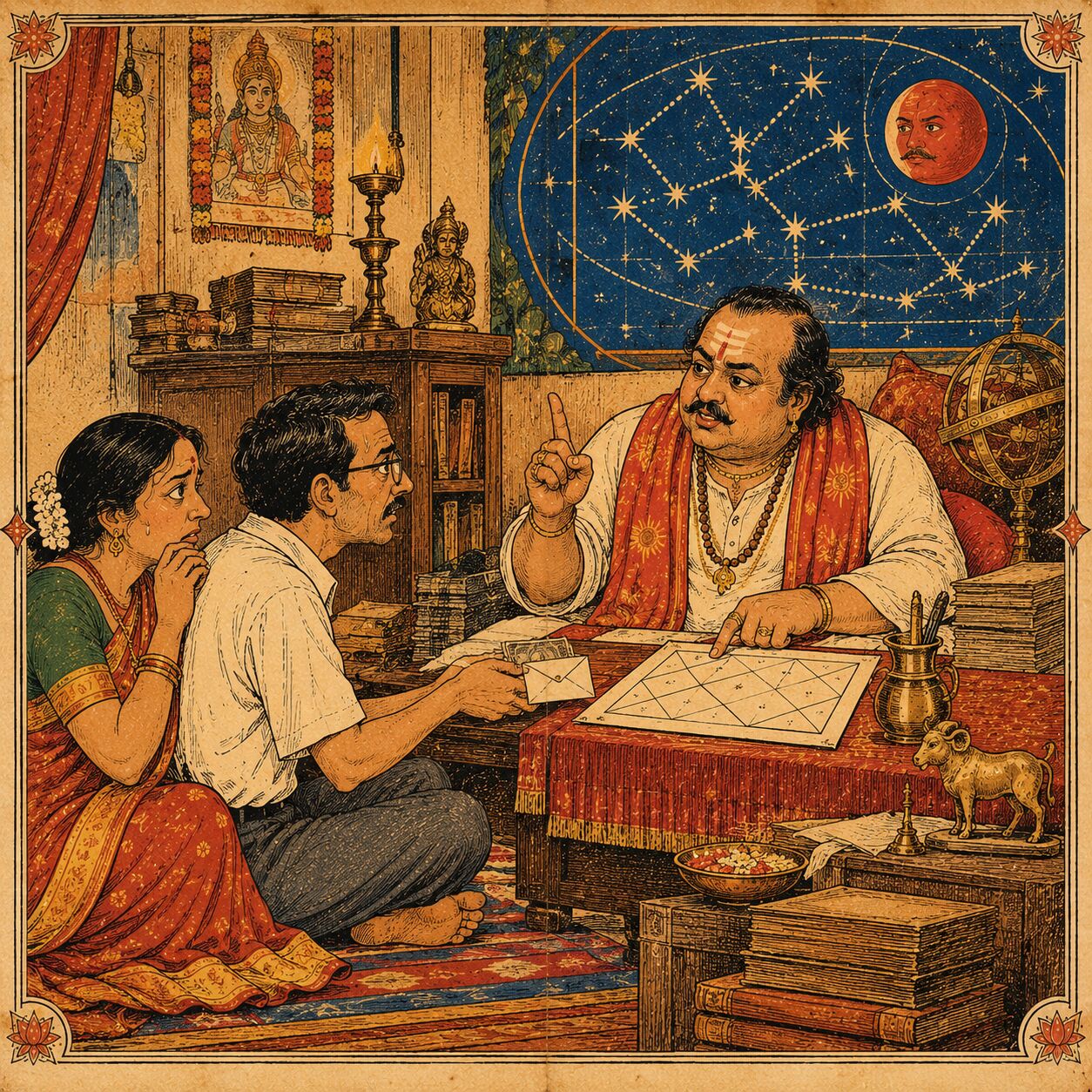
When a worried ‘customer’ hears this from the Jyotishi, it scares him. Fear is the emotion that lets the Jyotishi milk a lot of money from his customer. The Jyotishi knows the customer is already in some kind of trouble; otherwise, why would he or she be sitting in front of a Jyotishi? The customer is meek and will never question the Jyotishi. This is the first pitfall.
Fear is the Jyotishi’s easiest fee.
The 12 houses are called Bhav, which means expression.
These 12 expressions are, broadly, 12 spheres of life. Each Bhav has multiple layers and indicates more than one aspect of its sphere. Subtle connections exist at various levels, and grasping them takes effort. For example, the 6th Bhav indicates service, shows your enemies, shows your health, and so on. A cursory look suggests these have nothing in common, but they are all related. Enemies are not always external; illness and disease are our primary enemies. And one needs to be fit, healthy, to be of service. This is just one layer of understanding this Bhav. That understanding is taken further through the concepts of Dharm, Arth, Kaam and Moksh. (Leaving Satvik, Rajasik and Tamasik aside for now.)
Now, back to Mangal Dosh, which has to do with an imbalance of Martian energy. Mars is the warrior, the commander-in-chief of the armies, responsible for the ‘energy’ a human possesses. If Mars is in the:
1st Bhav, it indicates a highly energetic person (physically).
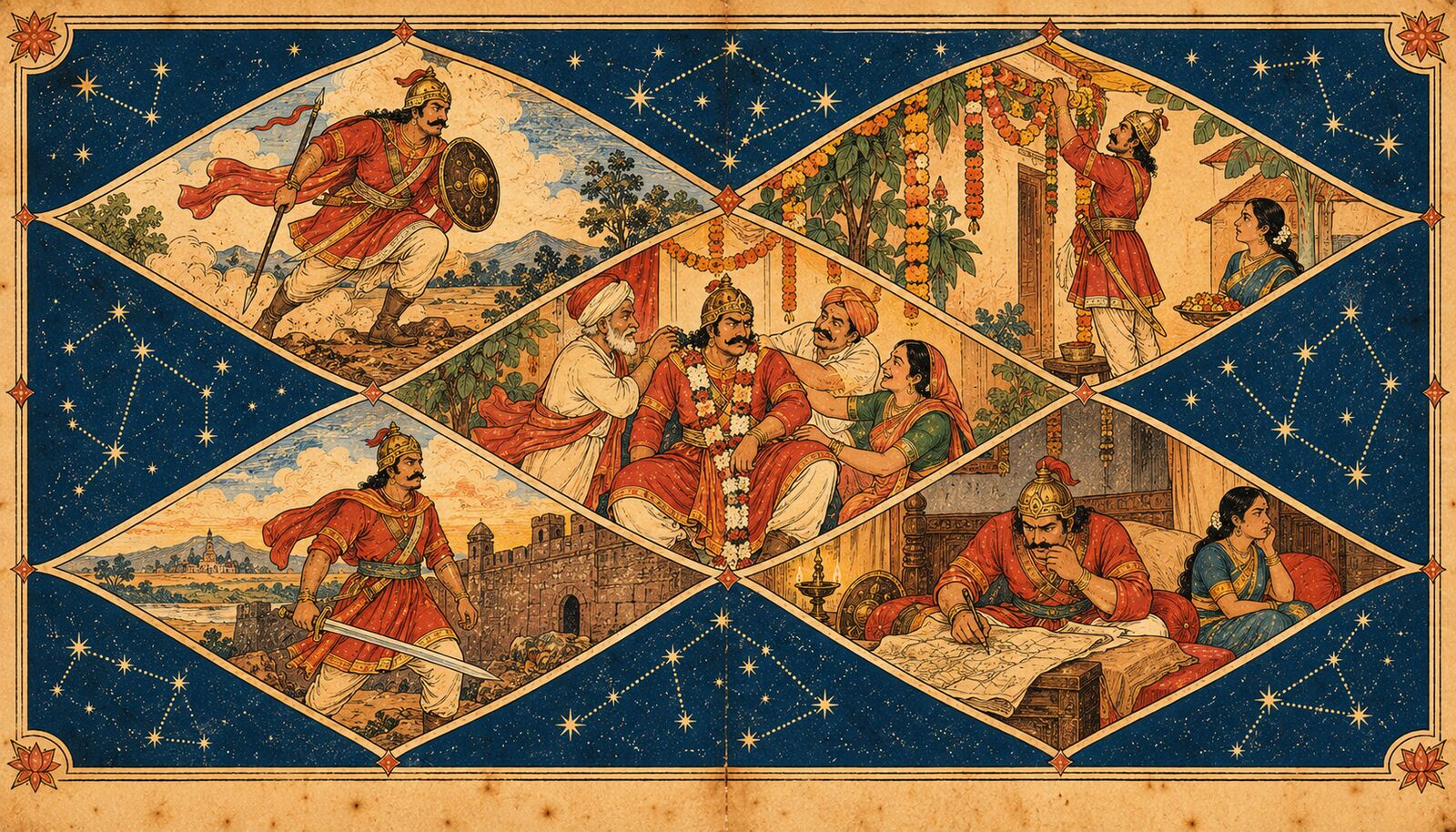
4th Bhav, it is like a soldier armed to the teeth who is given the task of decorating the house and settling into a homely mood.
7th Bhav, it is like a celibate soldier being forced into marriage.
8th Bhav, it is a dedicated soldier given a free hand to kill.
12th Bhav, it is a soldier obsessed with war strategy who is made to play bedroom games.
The same soldier, posted to five different houses.
These are just a few interpretations based on the position of Mars in those Bhavs. Just as there are rules for Mangal Dosh, there are rules for its cancellation. In fact, there are more rules for cancellation. I am not detailing them here, because it all gets technical and needs a much wider explanation; maybe later we can delve into them.
Rules of cancellation
Look at how a single planet, by its position alone, can create multiple possible outcomes. Now add another rule: these positions of Mars give slightly different results for women and men. This is why we see a myriad of opinions. There is a huge amount of leeway, scope and wriggle room for the astrologer to use for his own benefit.
Let us look at this from another perspective: pure mathematical probability.
If Mars occupying 5 of the 12 houses makes one Manglik, simple maths gives roughly a 42% chance of any person being Manglik.
If we take the extended rule of 7 houses, that chance rises to roughly 60%.
5 of 12 ≈ 42%
7 of 12 ≈ 58%
If Mars could sit in any of the twelve houses with equal chance, this is how many people the rule would brand Manglik.
That would make 60% of the world unmarriageable for non-Mangliks, or at least marriages would be dissolving left and right. But this runs counter to what we observe in the real world!
Mars alone cannot cause that much damage. In Jyotish, a planet is never considered in isolation. The cancellation rules for Manglik Dosh show how other planets reduce the effect of Mars. So Mars being present in one of those five houses does not, by itself, make a person Manglik.
Never alone
Also, the effects of this Dosh as stated in the classics cannot be assumed to hold good today. After all, one basic rule a Jyotishi must follow is the principle of Desh, Kaal and Paristhiti (DKP): place, time and circumstance. Mars is quite important for love marriages, but what we in India call a love marriage is not the same as in Western countries. That is why keeping the DKP principle in mind is a must.
Ripening at 28
Let’s say that, despite all these escape clauses, a person still turns out to be Manglik. Will that person suffer all their life? The answer is an absolute, resolute NO. Every planet has its ‘maturing’ age, and for Mars it is 28.
This means the planet exerts itself strongly once the native reaches that age. It is a bit hard to explain, but one can compare it to a flower blooming or a fruit ripening. These happen at precise moments; similarly, planets mature at precise moments. Mars exerts itself from 28 to 32, and after that it mellows. It is just as, with age, a person’s energy begins to decrease and he starts to prefer using the brain (as in patience) over physical strength.
Broadly speaking, the issue of Manglik subsides by 32, and by 35 at the latest.
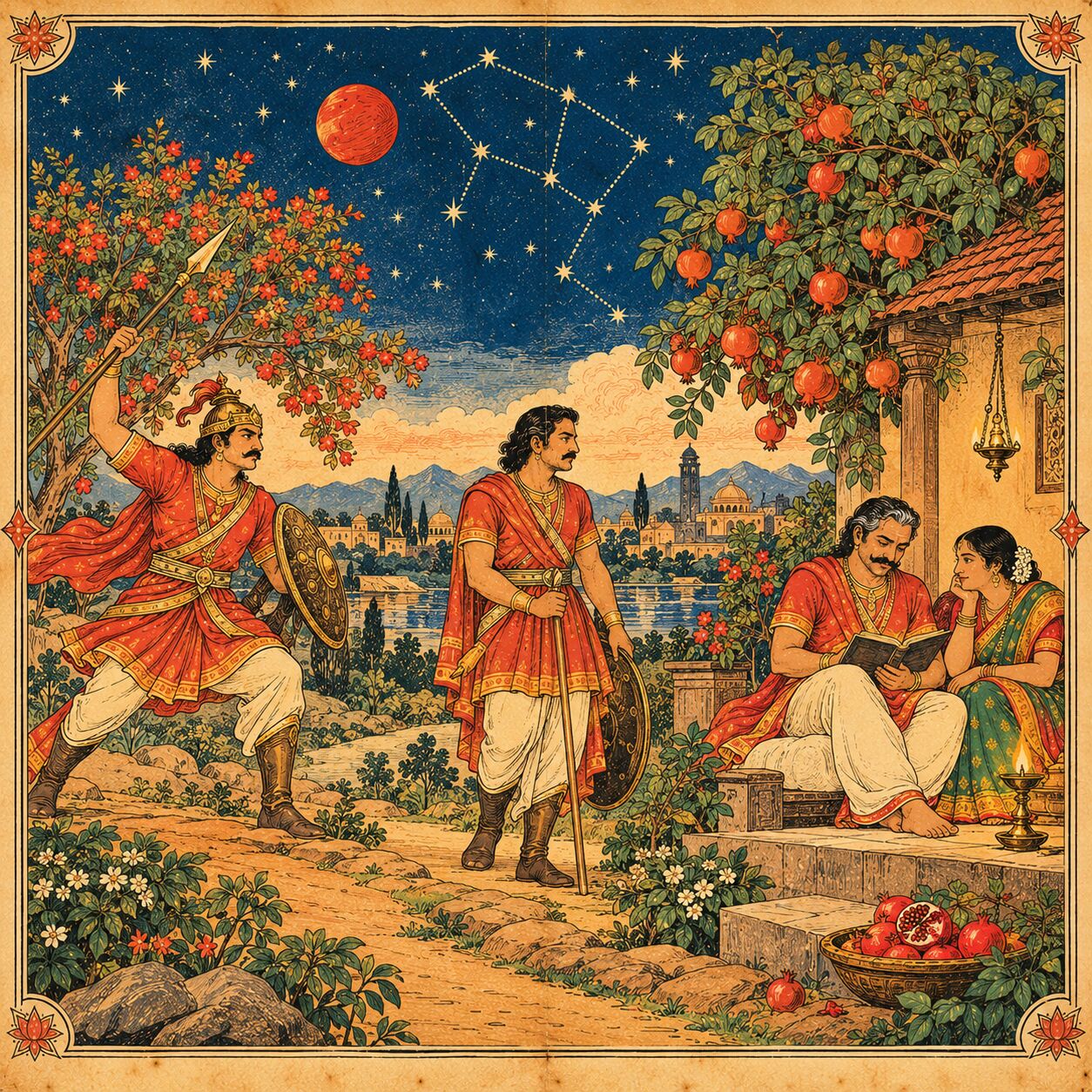
Mars ‘ripens’ at 28 and exerts itself until about 32; by 35 at the latest, the issue subsides.Mars ripens at 28, and mellows soon after.
Again, remember that this holds only when Mangal still causes the Dosh after all the cancellation rules have been applied. Such cases are very rare.
All in all, the clear conclusion is: never take such an infamous Yog at face value.Dagadu D
One must also see that these rules and their effects were set in a period when life expectancy was around 40, job options were limited, and a large part of the populace served as soldiers. The impact of Manglik Dosh was naturally limited to the times in which it was formulated (as per DKP). Today we need to adapt such concepts to the current century.
Adapted to today
In the case of Manglik, a single Yog, we can see how much thought its application requires. And all this without touching on the Nakshatras and how they play in this context.
With the Nakshatras, each step gets even finer:
Planet in Bhav
Rashi
Nakshatra
Nakshatra Pad
Exact degree
= result
Each step narrows the reading further.
Again, each of these steps has its own iterations of Dharm, Arth, Kaam and Moksh, and of the elemental natures: Fire, Water, Earth and Air. The finer you go, the tougher the analysis. Fiery Mars has a very tough time in a Water sign like Cancer, since water douses fire. The same fiery Mars is happy in airy Gemini, since air feeds fire. In this way one can keep refining the results to resolve the Karma they indicate.
At the end of the day, one has to accept that, like the Vedas, Jyotish cannot be understood in one sitting, that is, in one lifetime. Besides, Jyotish is not designed to be a know-it-all, because a know-it-all study would run counter to the very notion of Karma. Jyotish does not intend for people to give up and leave everything to destiny. Not knowing everything pushes one to create new Karma and balance the old. No Jyotishi will ever be able to read 100% of a native’s chart; otherwise free will would be futile.
Since we have grown up with a slightly scientific bent, instead of following things superficially and blindly, we must explore this aspect of our being and approach Jyotish accordingly. One cannot, or rather must not, forget that the planets the Jyotishi speaks about affect him too. They are part of his active Karma, and he is not free from fallacy. We have entered the Age of Aquarius, which means knowledge will be shared and all that is false will fall away. As the popular paraphrase of Max Planck goes:
“Science progresses one funeral at a time.” So will Jyotish.