Ravan, the nine Grahas, and the one who stepped outside the circle.
By Dagadu D
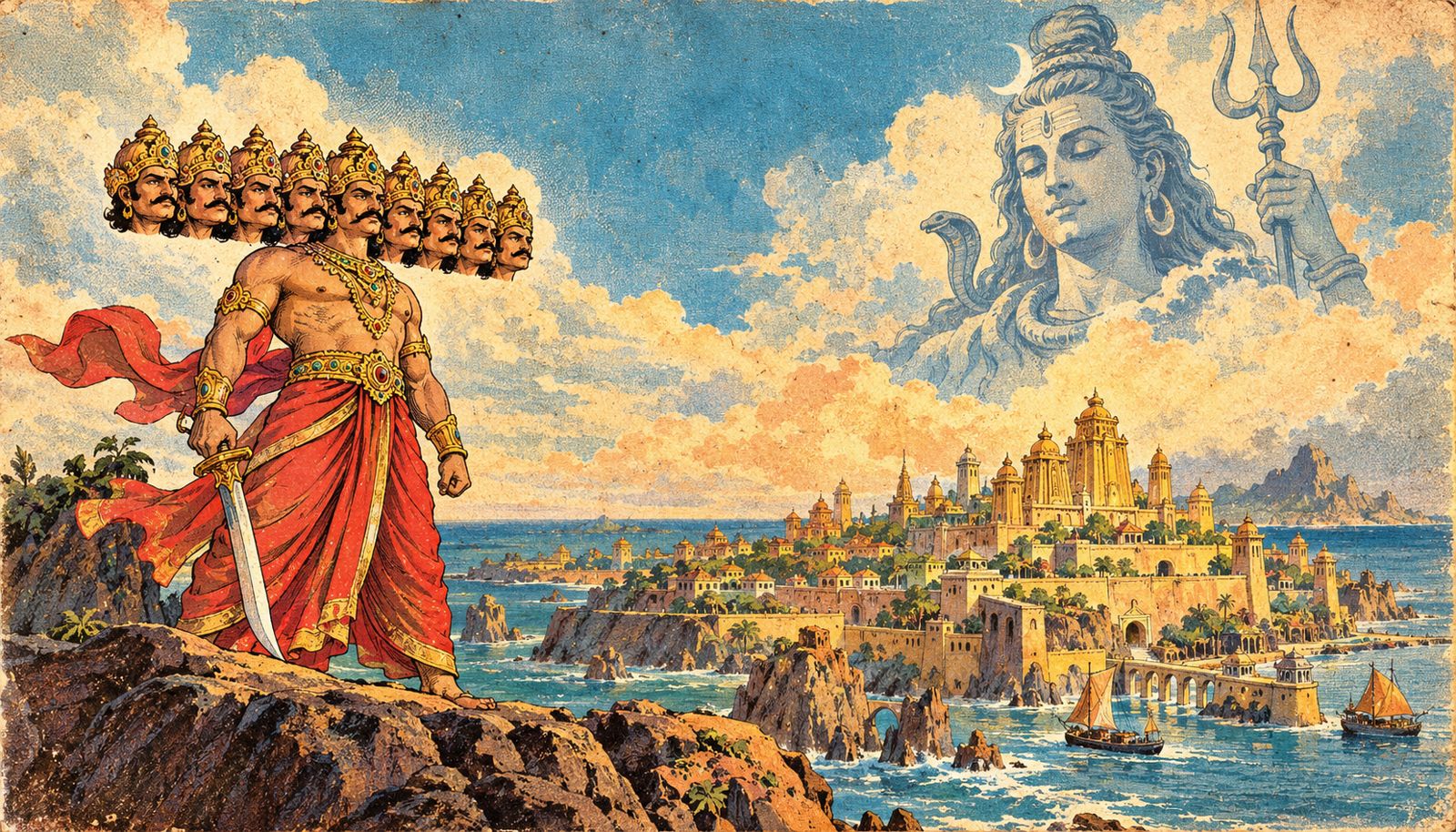
Dashagriva, the unconquered ego, master of the three realms, above a Lanka still made of gold.
Mythology and Itihaas are just labels, and some may find it controversial if I place Jyotish under a similar label. Jyotish weaves mythological fables into its narration, and through them it explores the human condition.
One such fable rises from the much-celebrated Ramayana, and from its prime antagonist, Ravan.
Ravan is a study in contradictions: king of the Asuras, master of the three realms, and yet a slave to his own ego.
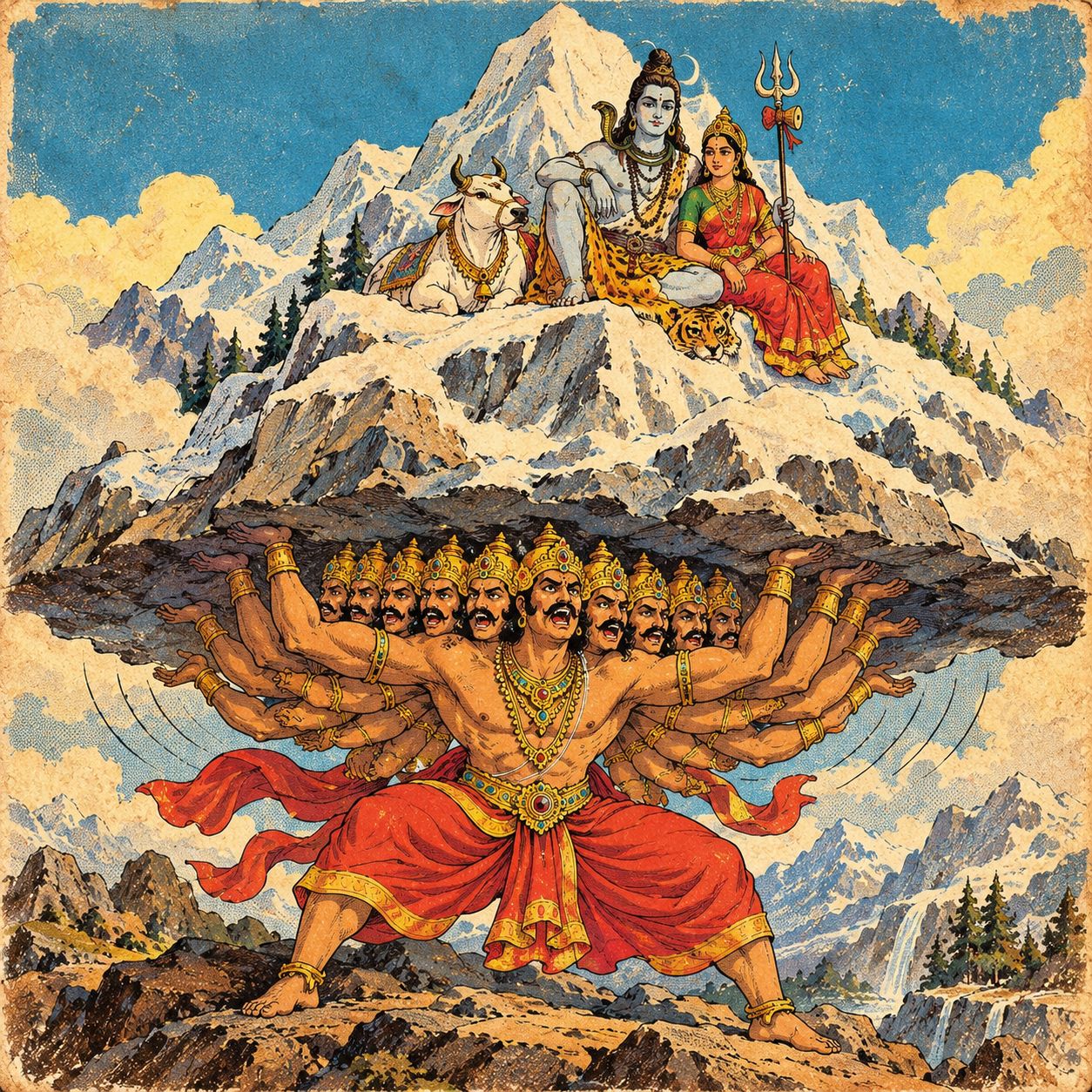
He was not always Ravan. He was born Poulastya, the grandson of Maharishi Pulastya. Through rigorous penance he mastered the ten sacred texts and earned the name Dashashan (the ten-headed). Others called him Dashagriva, the ten-necked: ten heads, ten necks, ten sacred texts held in a single mind. Yet his ego never left him. In one such rush of ego, Dashashan audaciously tried to lift Mount Kailas, with Lord Shiva meditating on its summit. Shiva, who has the power to destroy the universe, merely flexed his toe. The mountain pressed down, crushing Dashashan beneath it. He let out a scream of agony, a roar that shook every corner of the universe. Such a loud, roaring scream is called Ravan.
Hence, Dashashan came to be known as Ravan.
To escape the crushing weight of Kailas, Ravan had to appease Lord Shiva. To earn Shiva’s forgiveness, he composed the Shiv-Tandav Stotra in the Panchachamara metre: Sanskrit poetry with sixteen syllables to a line, an unparalleled feat. With alternating short and long syllables and an apt use of alliteration and onomatopoeia, Ravan created a rumbling, ravaging rhythm that mimics the formation of the cosmos, the primordial Tandav dance of Shiv.
Ravan composing the Shiv-Tandav Stotra beneath Mount Kailas.
And remember, Ravan composed this marvellous gem while bearing the weight of an entire mountain on his shoulders. Such was his mastery.
This story offers a glimpse of Ravan’s might and intellect. He was master of the Vedas, all the Vedangas, every Shastra and every Kala. How could he not have mastered the Jyotish Shastra too?
The testament to that mastery is the Ravan Samhita, a work regarded to this day as the most potent text on Jyotish.
Since we are talking about Jyotish, let’s explore a tale that intertwines Ravan and Jyotish Vidya.
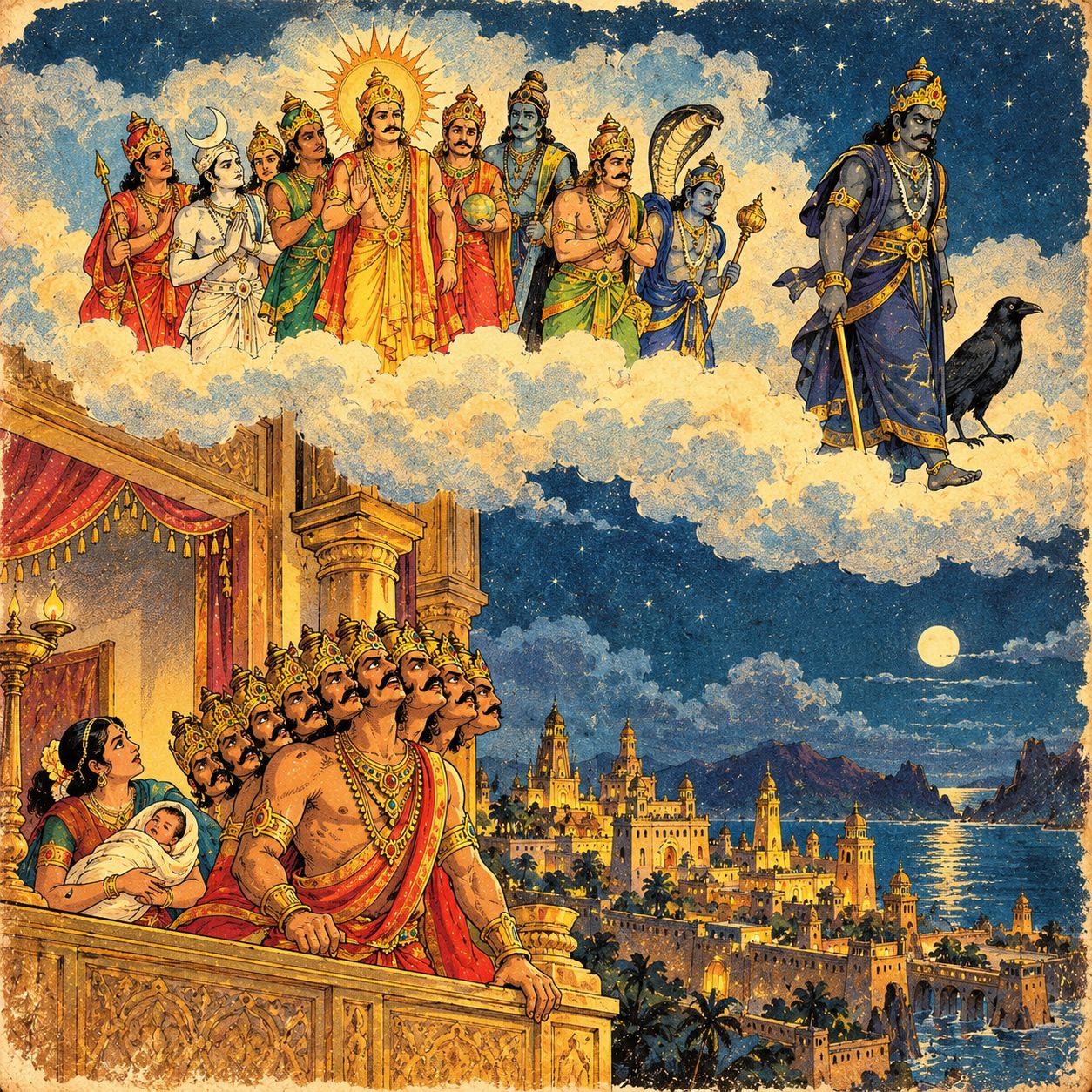
Ravan wanted his son, Meghnad, to be invincible and immortal. As the hour of Meghnad’s birth drew near, Ravan, the master of Jyotish, knew exactly what was at stake. He seized the Navagrahas and commanded all nine to stand together in the eleventh house, the house of gains and fulfilled desires, at the moment of his son’s birth.
The Grahas trembled and obeyed. All but one.
Shani, the keeper of karma, quietly slipped a single step away, into the twelfth house, the house of loss. That one step left a flaw in Meghnad’s destiny: for all his power, he would not be immortal.
Meghnad’s birth chart as Ravan ordered it, and as it was. Eight Grahas crowd the eleventh house; Shani stands alone in the twelfth.Eight Grahas obey. Shani takes one step away, and Ravan watches from the window with his newborn son.
Ravan was enraged. He struck Shani’s leg with his mace and left him lame; Shani, the tradition says, has moved slowly ever since. Ravan then had every Graha tied face-down to the steps leading up to his throne. Shani suffered the greatest ignominy: his head became the footrest of the seated king.
Ravan’s throne, the Navagrahas bound on its steps. Narad Muni waits at the side.
The signs were ominous for the Devas. Ravan controlled everything. He had already conquered the realms, and with the Grahas forced to obey him, he now owned the future as well. In desperation, the Devas turned to Narad Muni for relief. Narad Muni agreed to try and travelled to Ravan’s court. In his typical style, he began by massaging Ravan’s ego and then went on to provoke him.
“It is far more glorious to walk over your enemies while staring into their eyes.”Narad Muni, in Ravan’s court
Ravan immediately ordered the Grahas turned from face-down to face-up.
The Grahas were still bound, unable to move or do much harm, still trampled under Ravan’s will. But lying face-up, Shani’s gaze was set free.
Shani’s gaze works in silence. It does not strike like lightning; it creeps up on a person slowly, the way damp creeps into a wall, unseen until the plaster begins to fall. Ravan did not notice when it began.
The learned king, who knew the Vedas and knew the importance of respecting women, could not apply that knowledge to his own actions. Ravan abducted Sita. Knowledge that is held but not lived is the first thing Shani tests, and Ravan failed at the very first step.
Then came the counsel he would not hear. His brother Vibhishan begged him to return Sita and make peace; Ravan drove him out of Lanka. His queen Mandodari pleaded with him; he waved her away. When Hanuman set Lanka ablaze, when Rama’s army bridged the sea, when his brother Kumbhakarna fell in battle, Ravan could still have turned things around. Each time, his arrogance stood between him and sound advice.
Last came the blow he could not bear. Meghnad, who had once defeated Indra himself and earned the name Indrajit, fell to Lakshman’s arrows. The son whose stars Ravan had arranged with his own hands, the son who was meant to rule the realms, died before his father. The single step Shani took at his birth had come due.
The same king, the same city. Lanka burns.
All that Ravan held dear withered before his eyes, yet, blinded by arrogance, he saw nothing. That is Shani’s modus operandi. When Shani acts, he takes it upon himself to shatter all that is fake, unreal and false; to empty you, to strip you of everything, until all that is left is You. Shani makes one see the truth in the hardest way possible: by destroying all the Maya one holds dear.
Ravan’s destruction raises many philosophical questions. What is ego? What is arrogance?
Myths, Itihaas, Vedas, Upanishads, Jyotish: what are these? Some take them at face value, either as stories to be enthralled by or as prescriptions for life. Can we slot the story of Ravan’s tryst with the Grahas into such simple formulas? Or can we aspire to explore the many layers of philosophical inquiry beneath them?